
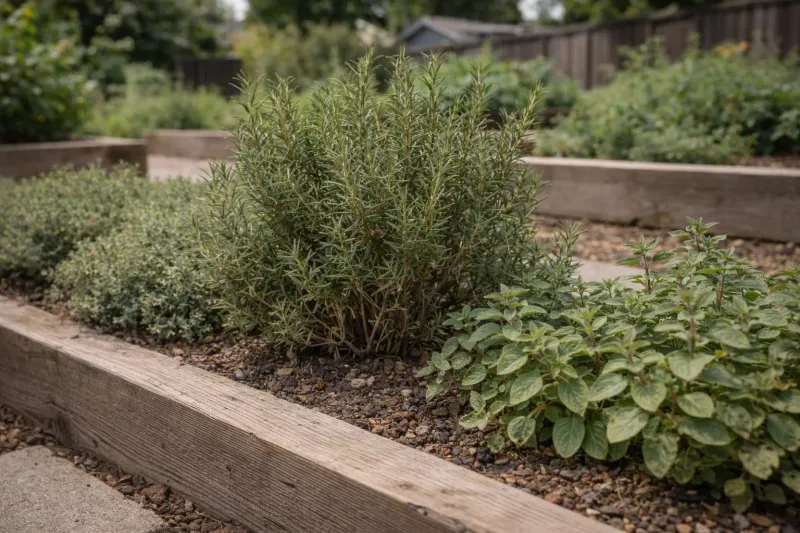
Rosemary is one of the most popular plants in California gardens, and for good reason. It smells great, handles dry summers well, and looks tidy along a walkway or fence.
But for homeowners in wildfire-prone neighborhoods, where rosemary sits in the yard matters more than most people realize. Understanding how this familiar herb behaves near a house during fire conditions can help you make smarter choices about where and how you grow it.
Why rosemary deserves a closer look in wildfire-prone yards
Rosemary has earned its place in California gardens. UC IPM notes that it thrives in full sun with good drainage and little to moderate water, which makes it a natural fit for the state’s long, dry summers.
Gardeners use it as a hedge, a border plant, a ground cover on slopes, and an edible accent that doubles as landscaping. None of that changes.
What does deserve attention is where rosemary sits relative to the house, especially for homeowners in wildfire-prone communities. UC Agriculture and Natural Resources firewise guidance identifies aromatic plants such as rosemary as relatively more combustible choices in fire-prone landscaping.
The concern is not that rosemary is categorically dangerous or holds some statewide ranking above all other plants. The concern is specific: certain characteristics make it a higher-flammability option compared to some lower-oil, high-moisture alternatives when conditions are right for ignition.
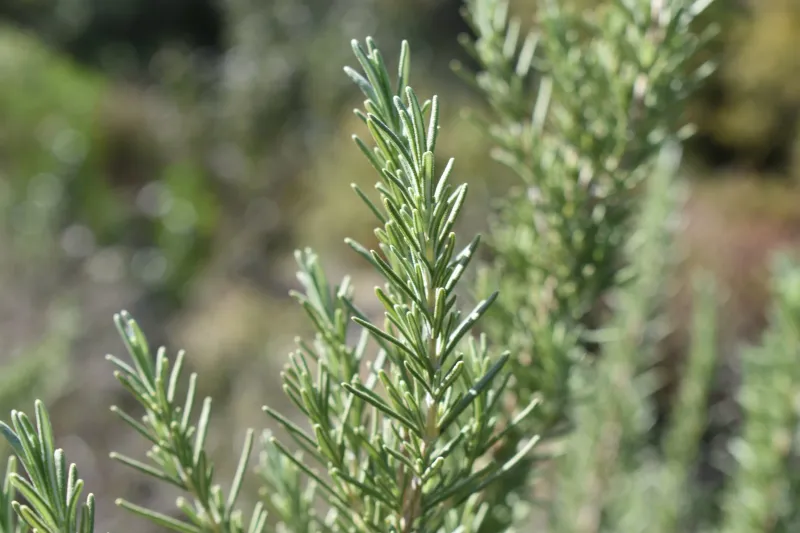
Those characteristics include aromatic foliage loaded with volatile compounds, fine needle-like leaves that dry and carry flame readily, a woody branching structure that accumulates dead material inside the plant over time, and a growth habit that can form dense, connected fuel when left unmanaged. A large, drought-stressed rosemary hedge planted against a wall is a meaningfully different situation than a small, well-spaced, maintained plant a safe distance from the structure.
UC fire safety and firescaping guidance is clear that no plant is truly fireproof, and that relative fire resistance depends on moisture, maintenance, spacing, and exposure conditions. Rosemary’s place in that conversation is as a plant that warrants honest placement decisions, not as an automatic threat or a source of alarm for every California homeowner who grows it.
The plant’s chemistry and structure can add combustible fuel
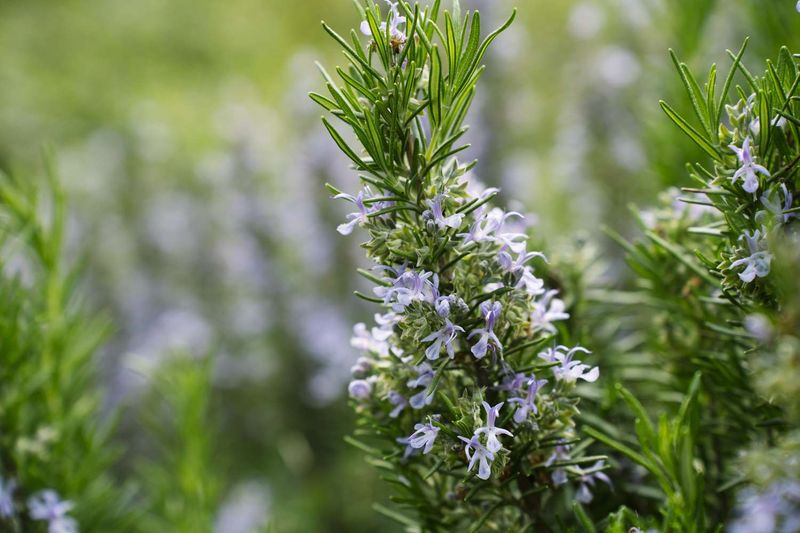
Cut a sprig of rosemary and the smell hits immediately. That fragrance comes from terpenes and other volatile organic compounds stored in the plant’s foliage and woody tissue.
Under ordinary garden conditions, those compounds make rosemary pleasant. Under fire exposure, they matter for a different reason.
A peer-reviewed study on Rosmarinus officinalis found that terpene production and storage increased the plant’s flammability, supporting the idea that rosemary is chemically predisposed to burn more readily than some low-oil, high-moisture plants. This research examined plant-level flammability mechanisms, not how often rosemary causes home ignitions in real wildfire events.
The finding is useful for understanding why aromatic plants show up on firewise plant lists as higher-flammability choices, not as evidence that a garden rosemary bush poses a spontaneous danger.
Older U.S. Forest Service guidance on chaparral-urban interface landscaping also categorized rosemary among plants with inherently higher flammability during fire season, pointing to oil content and fine-fuel characteristics as the relevant factors.
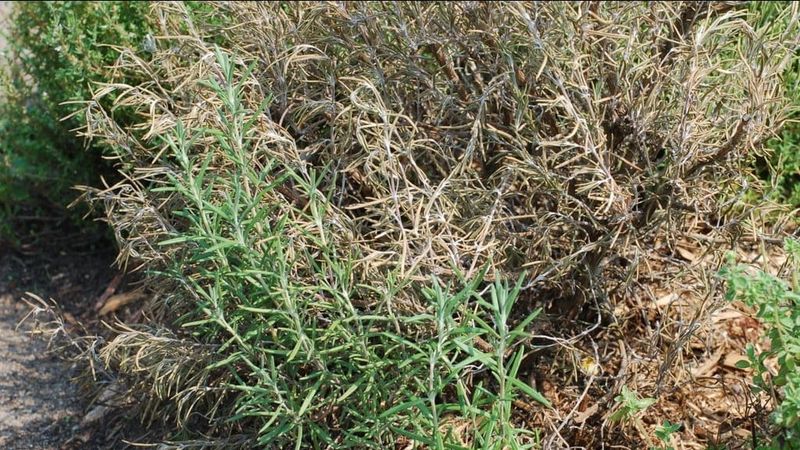
Fine foliage, meaning the narrow needle-like leaves, can dry out and ignite more easily than broad, fleshy leaves with higher water content. As a rosemary plant matures, dead branches and dry debris accumulate in its interior, adding ready fuel that is often hidden beneath the green outer growth.
The woody branching structure compounds this. Older plants develop a dense, tangled core that traps dry material and can carry flame from one part of the plant to another.
Research on volatile compound emissions from heated rosemary examined extreme external heat conditions, not routine backyard scenarios. Rosemary does not release a self-igniting cloud or produce fireballs in a normal garden setting.
What the chemistry does mean is that when fire exposure arrives, whether from embers, flame front, or radiant heat, rosemary tends to catch and sustain combustion more readily than some alternative plants with lower oil content and higher moisture.
Five feet defines a high-priority near-building zone
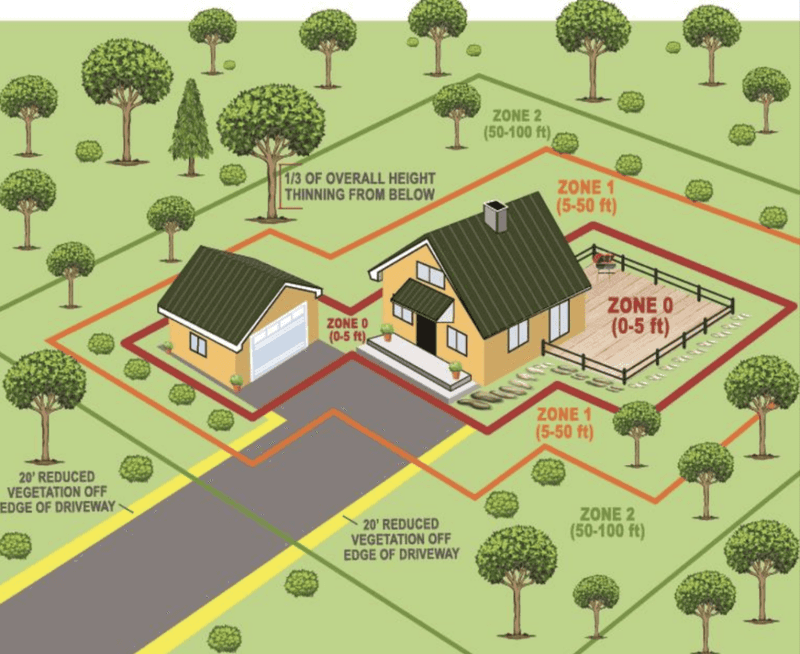
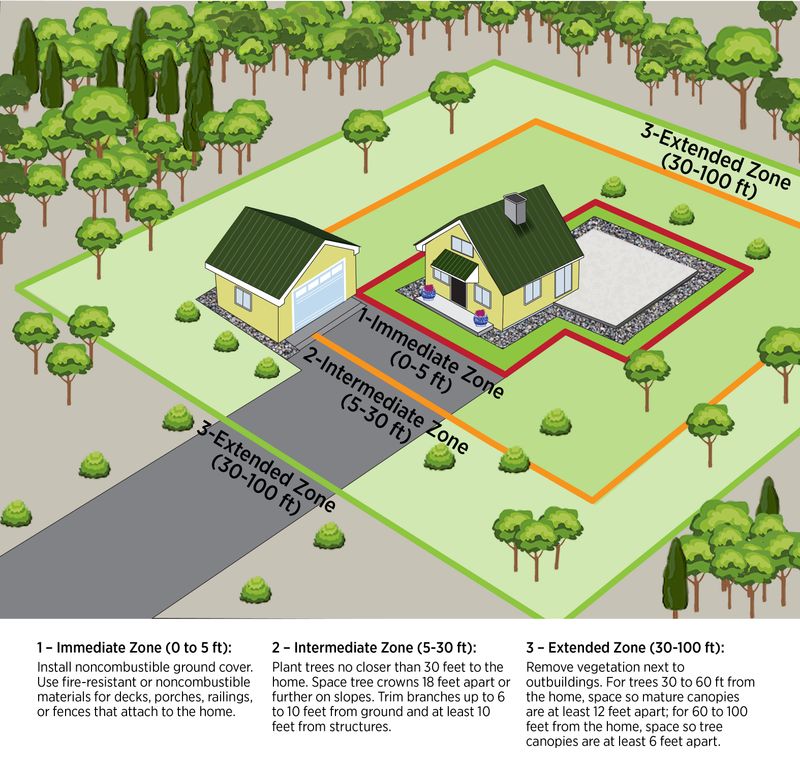
The first five feet around a structure carries more weight in wildfire home protection than most homeowners expect. CAL FIRE’s defensible space guidance and California Board of Forestry materials on Zones 0, 1, and 2 identify this immediate perimeter as especially important because embers landing on or near combustible vegetation next to the building can ignite that material and expose the structure directly to flame contact or radiant heat.
That sequence, ember to plant to building, is one of the most common ways homes catch fire during a wildfire event.
This near-building zone is sometimes called Zone 0, and its guiding concept is straightforward: keep the area immediately surrounding the structure as noncombustible as practical. The five-foot figure is not a rosemary-specific measurement derived from herb research.
It applies broadly to combustible vegetation, wood mulch, stored materials, and anything else that could carry fire to the building’s exterior, vents, windows, or decking.
IBHS testing on vegetation in Zone 0 reinforces why the distance matters. Plants placed close to a structure give embers a stepping stone from the landscape to the building itself.
The closer combustible material sits to the wall, the shorter the path that fire needs to travel to reach vulnerable spots like vent openings, wood siding, or window frames.
One practical point worth stating clearly: risk does not flip from dangerous to safe at exactly five feet and one inch. A shrub at six feet is generally a lower concern than one at two feet, but placement is one factor among several that include plant condition, density, connection to other fuels, wind, and slope.
IBHS guidance on the near-building noncombustible zone frames this as a priority area for reducing ember and flame exposure, not as a line that resolves all wildfire risk on its own. Treating the first five feet seriously is a high-value starting point, not the finish line.
Green and watered does not mean fireproof
A common assumption in California gardens is that a green, regularly irrigated plant is effectively safe during fire season. Healthy vegetation does carry real advantages.
UC safe landscapes guidance confirms that high plant moisture can reduce fire risk and that keeping plants well-watered through summer is a meaningful part of fire preparation. Drought-stressed vegetation, with its lower live fuel moisture and drier fine material, is generally a greater immediate concern than a plant receiving regular irrigation.
The problem is that “green” and “fireproof” are not the same thing, and the difference matters most in the near-building zone. IBHS testing found that even well-watered vegetation within five feet of a structure can ignite and increase heat exposure during wildfire conditions.
Wildfire heat and ember showers are not the same as a small flame from a lighter. They can overwhelm a plant’s moisture advantage, especially when the plant is large, dense, or connected to other combustible material.
Rosemary adds a complicating layer here. Its outer foliage may look green and hydrated while its interior holds a network of dry, dead branches and accumulated debris that irrigation does not reach.
That hidden dry core can catch and sustain combustion even when the plant appears healthy from the outside. Recent landscape-plant flammability research indicates that plant mass, branching structure, and internal dead material affect combustion behavior across many species, not just during obvious drought stress.
Wind and slope amplify these factors. A rosemary plant on a downhill slope from the house, or in a spot that channels wind toward the structure, presents a different exposure than the same plant on flat ground in a sheltered corner.
Moisture helps, but it does not neutralize proximity, mass, connected fuels, or the intensity of ember exposure that arrives with a wildfire moving through a neighborhood.
Start the correction at the foundation
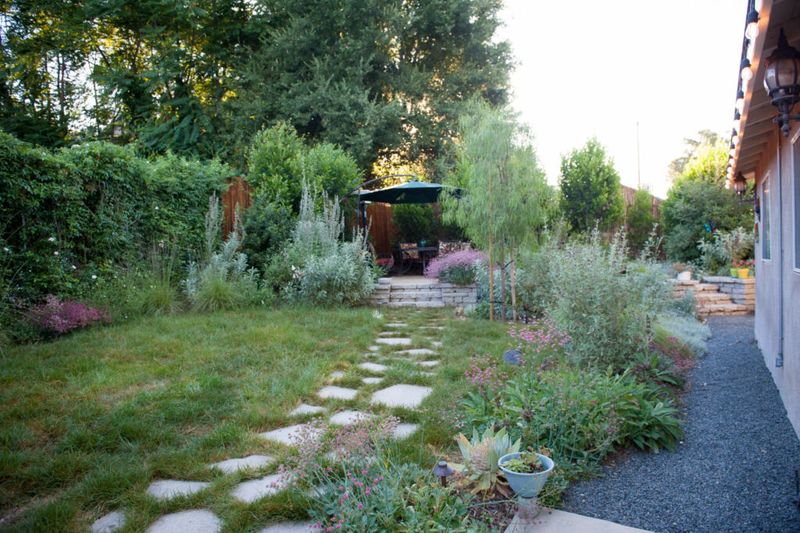
For homeowners in wildfire-prone parts of California, the most direct correction starts at the building’s edge. CAL FIRE’s defensible space guidance recommends keeping the first five feet around a structure free of combustible vegetation and materials, using hardscape such as gravel, concrete, or pavers in that zone where permitted and appropriate.
Removing rosemary from that immediate perimeter and replacing it with a noncombustible surface takes away one of the key pathways from a landscape ember to a building ignition.
This is not a rosemary-only rule. Any combustible vegetation, including other aromatic shrubs, ornamental grasses, wood mulch, and accumulated leaf litter, warrants the same treatment in that near-building band.
Rosemary comes up specifically because it is so commonly planted close to walls, along foundations, and beneath windows, exactly the spots where proximity matters most.
For rosemary that remains farther out in the yard, the goal is managed separation rather than elimination. UC guidance on plant spacing and maintenance emphasizes that how plants are arranged and cared for can matter as much as species selection.
Keep individual plants spaced so they do not form a continuous fuel mass. Remove dead branches and interior debris regularly, because that dry core is where combustion tends to start.
Prevent the plant from touching the house, roof overhang, deck, fence, or adjacent shrubs, since contact creates a direct fuel connection between the landscape and the structure.
Growth habit matters too. A rosemary plant trimmed into an open, airy form presents less accumulated fuel than one allowed to become a dense, impenetrable hedge.
UC’s wildfire surroundings and plant guidance supports this approach, noting that open growth and cleared surroundings reduce the fuel available to carry fire.
Local requirements may go further than state minimums. The California Board of Forestry’s Zone 0 materials are still being refined, and cities, counties, and fire protection districts may already have stricter standards in place.
Before finalizing any landscaping plan, check with your local fire department or fire district to confirm what applies to your specific property.
Check the whole home ignition zone
Pulling rosemary out of the near-building zone is a meaningful step, but it is not the end of the job. California’s Office of the State Fire Marshal estimates that embers cause 60 to 90 percent of home ignitions during wildfires, and those embers do not only land in garden beds.
They settle into gutters filled with dry leaves, collect on wood decks, enter attic vents, lodge against siding, and accumulate on window sills. Every one of those spots is a potential ignition point that has nothing to do with what is planted in the yard.
A complete home ignition zone review covers the structure itself. Gutters should be cleared of leaf and needle debris before and during fire season.
Roof vents and soffit vents benefit from fine-mesh ember-resistant screening. Wood decks, especially those that connect directly to the house, can carry fire from the landscape to the structure as efficiently as any shrub.
Fences made of wood or vinyl that run from a gate or neighbor’s yard to the house create a fuel bridge worth considering.
The NFPA Home Ignition Zone Checklist provides a systematic way to work through these vulnerabilities, covering roofs, eaves, vents, walls, windows, decks, and the surrounding landscape together rather than treating each as a separate problem.
Rosemary is one plant on a longer list of potentially consequential landscape materials. Junipers, conifers, eucalyptus, ornamental grasses, and dry annual grasses can all present meaningful fuel loads depending on their condition, size, and placement.
CAL FIRE’s defensible space resources address wood mulch and accumulated leaf litter as well, both of which can smolder and carry embers to the building. Treating rosemary as one item in a broader inventory, rather than the single problem to solve, gives homeowners a more accurate picture of where their property actually stands.
Keep the herb, reduce the exposure
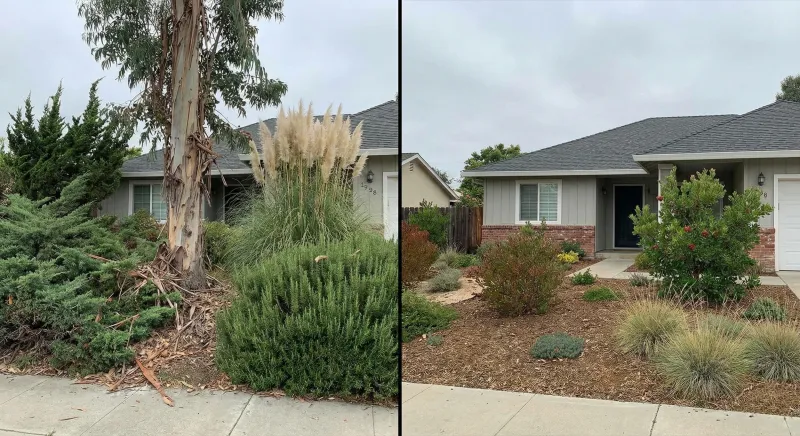
Rosemary does not need to disappear from a California yard. What it does need is honest placement and regular attention, especially for anyone living in a wildland-urban interface community, a Very High Fire Hazard Severity Zone, or a hillside neighborhood where ember exposure is a real seasonal possibility.
The practical sequence is straightforward. Clear the first five feet around the building of combustible vegetation and replace it with hardscape where local rules allow.
CAL FIRE’s defensible space guidance supports this as the baseline approach for that near-building zone. Any rosemary that stays in the yard beyond that perimeter should be maintained as separated, open-growing fuel, with dead material removed, spacing kept between plants, and no contact with structures, fences, or adjacent vegetation.
Inspect the full structure-ignition zone at least once a year, covering gutters, vents, decks, and siding alongside the landscape. Check the current Board of Forestry Zone 0 materials and confirm what your city, county, or fire district requires, since local rules may already be stricter than state minimums.
UC firewise plant guidance can help you evaluate whether alternative plants in your specific climate zone offer a lower-flammability option for spots near the house.
A yard that includes rosemary is not automatically a liability. A yard where rosemary grows untrimmed against the foundation, with dead material accumulating inside and a wood fence running the connection to the house, is a different situation entirely.
The herb is not the villain here. The placement is.