
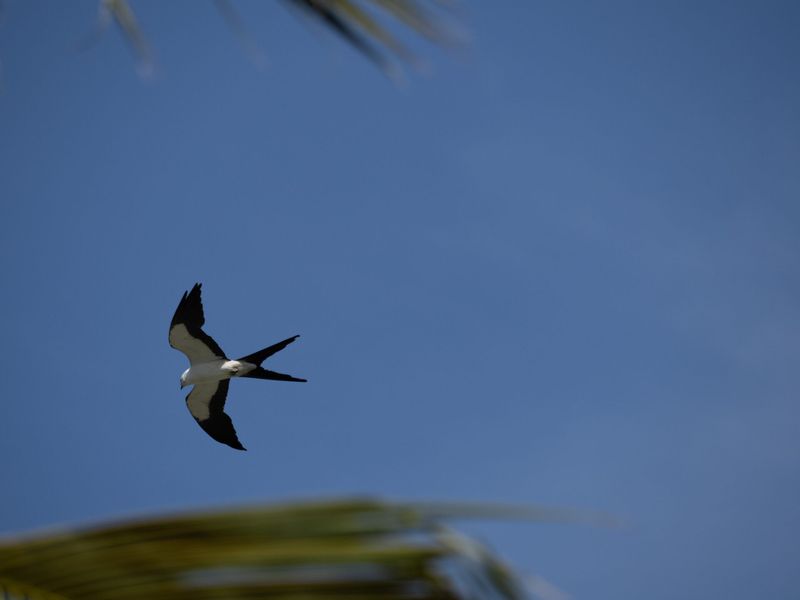
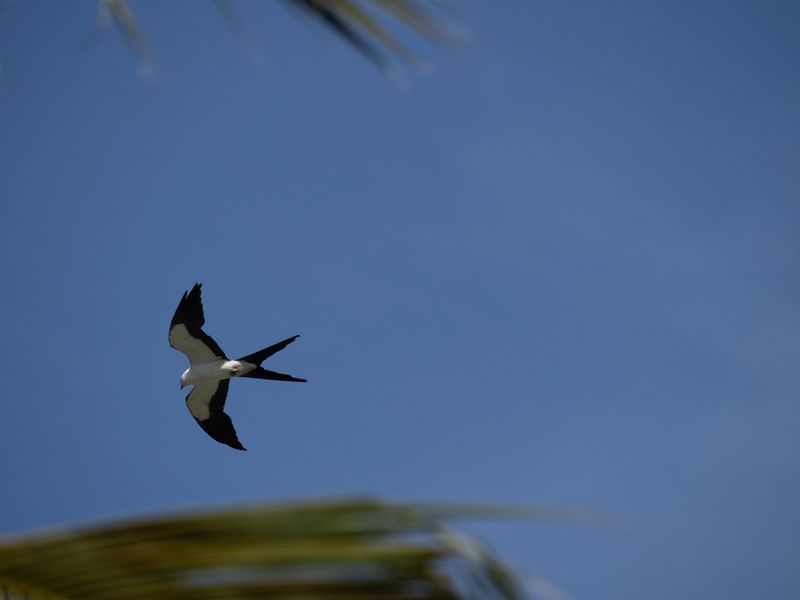
Every summer, Florida skies fill with the graceful, fork-tailed silhouettes of Swallow-tailed Kites swooping over yards, wetlands, and tree lines. Then, as August rolls into September, they seem to disappear almost overnight, leaving homeowners wondering what happened.
The good news is that this vanishing act is completely normal, and understanding why it happens makes it one of the most remarkable wildlife events in the state.
The summer kites are beginning a long southbound migration
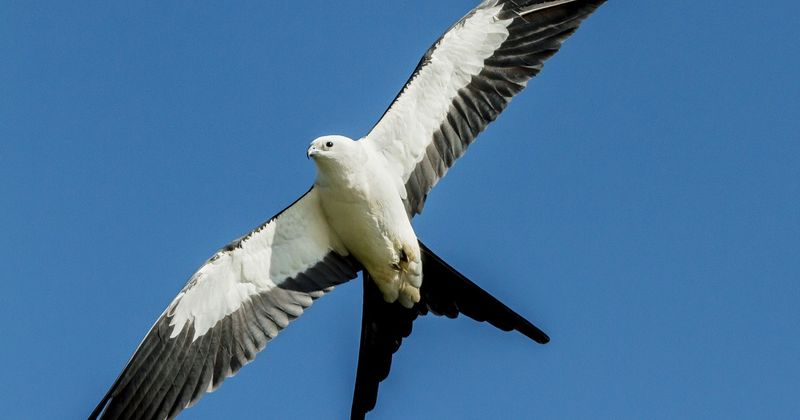
Across Florida each summer, those striking black-and-white birds with the deeply forked tails become a familiar part of the landscape. By late July, however, many of them are already on the move, and local skies can quiet down faster than most people expect.
The reason is straightforward: Florida Fish and Wildlife Conservation Commission confirms that Swallow-tailed Kites gather at communal roosts by early July before heading south on a long-distance migration toward South America.
The journey does not end in Central America. Tracked birds travel through or across the Caribbean, Mexico, and Central America before reaching wintering areas in places like southern Brazil, Bolivia, and nearby regions.
ARCI tracking studies have documented this broad geographic sweep, showing that routes vary considerably among individual birds.
For a Florida homeowner watching from the backyard, the change can feel sudden. Birds that were foraging over the neighborhood every day may simply stop appearing.
That shift usually reflects the natural pull of migration rather than anything gone wrong in the local environment. UF/IFAS Extension Sarasota County notes that the kites spend their Florida season breeding and feeding before making this southbound push, so an empty sky by late summer is exactly what the annual cycle looks like from the ground.
Fall marks the season, but it does not send every kite south
A common assumption is that some signal tied to autumn, a cool morning, the September equinox, or the first real drop in temperature, triggers a mass departure of kites all at once. The pattern is more layered than that.
Departures from Florida span a window extending from late July into September, and individual birds leave at different times depending on their condition, local food supplies, geography, and weather conditions they encounter.
One raptor migration reference compiled from historical tracking data identified August 10 as a median departure date for a particular dataset of Florida birds. That figure comes from a specific study sample and period rather than representing a fixed universal date that applies statewide every year.
That migration geography chapter also notes that the broader departure window extends well beyond any single median, meaning some birds are already gone before that date while others linger past it.
The U.S. Fish and Wildlife Service species account for the American Swallow-tailed Kite places fall departure from mid-August through late September, reinforcing that the window is genuinely broad.
Wind and weather can nudge individual birds to move on a particular day, but no single cold front or weather event is responsible for clearing Florida’s skies of every kite.
What readers notice as a fall phenomenon is really the tail end of a process that began weeks earlier. ARCI’s migration tracking work in Florida shows that the broader pattern follows the annual breeding cycle and the demands of long-distance travel, not a single environmental cue tied to the calendar date of autumn.
Breeding and preparation shape the departure
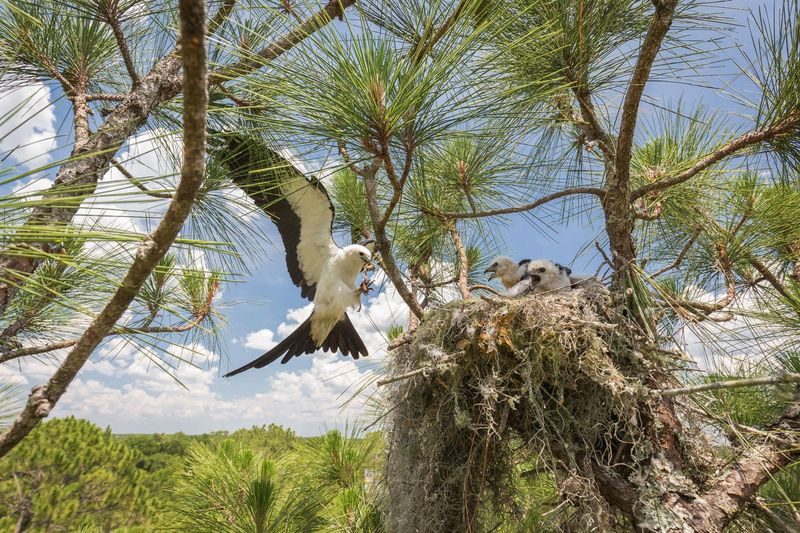
Long before a kite crosses the Florida Straits or catches a tailwind over the Gulf of Mexico, a whole season’s worth of biological work sets the stage. Breeding wraps up as summer advances, and once young birds have fledged and grown capable of sustained flight, the pressure to feed heavily and build energy reserves increases for the whole local population.
Cornell Lab’s life history account describes Swallow-tailed Kites as aerial hunters that catch flying insects on the wing and also take frogs, lizards, and small snakes during the breeding season. As summer progresses and migration approaches, pre-migration feeding becomes especially important, with birds fueling up for a journey that spans thousands of miles.
Departure timing varies among individuals. Some birds may be ready to move earlier while others spend additional time at pre-migration roosts.
ARCI researchers tracking kites from Florida documented birds building energy reserves at communal roosts and sometimes departing when winds offered favorable conditions for travel. That means weather can influence exactly when a particular bird lifts off, but the underlying reason for the departure is the species’ annual migration strategy, not a single storm or temperature drop.
FWC notes that the kites begin gathering at communal roosts by early July, which means preparation for migration starts well before most Florida residents notice any change in the sky above their neighborhood.
Communal roosts can make the change look sudden
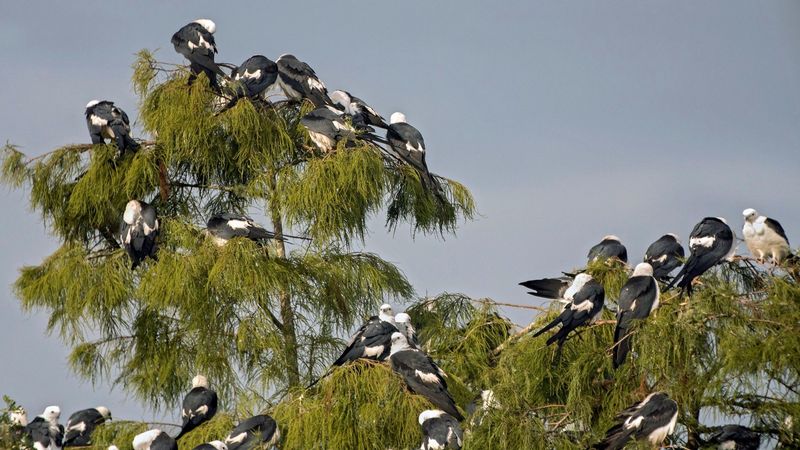
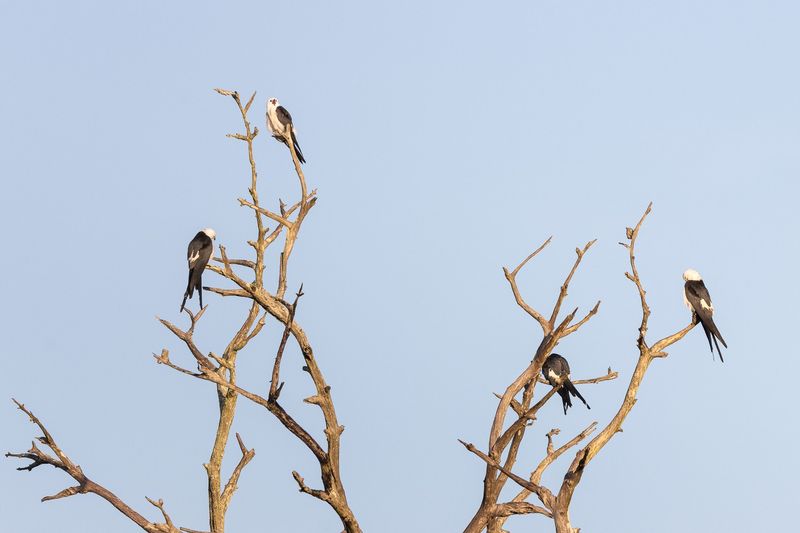
Part of what makes the kites’ departure feel so abrupt is that many birds do not simply drift away one by one. Instead, they concentrate at specific communal roost sites before migrating, which can pull birds off the foraging grounds that local residents are used to seeing them use every day.
FWC describes several strategic Florida roost sites used by a large share of the population during this pre-migration period. One of the most documented is Fisheating Creek, where FWC reports the summer roost can reach up to 3,000 birds at peak.
Not every roost reaches that scale, but gatherings of hundreds of kites in a single location are well documented across the state.
Palm Beach County Environmental Resources Management notes that several of these staging areas serve a substantial portion of the breeding population as birds funnel toward departure points. Meanwhile, Audubon Florida has documented staging activity at Corkscrew Swamp Sanctuary, another well-known gathering spot before the southbound push begins.
For a homeowner in a residential neighborhood, this means the kites that spent weeks hunting over nearby fields or tree lines may have relocated to a roost site miles away. The yard did not lose its appeal; the birds simply shifted to a different phase of their annual cycle, one that requires gathering with hundreds of others rather than spreading out to forage.
The route continues far beyond Florida
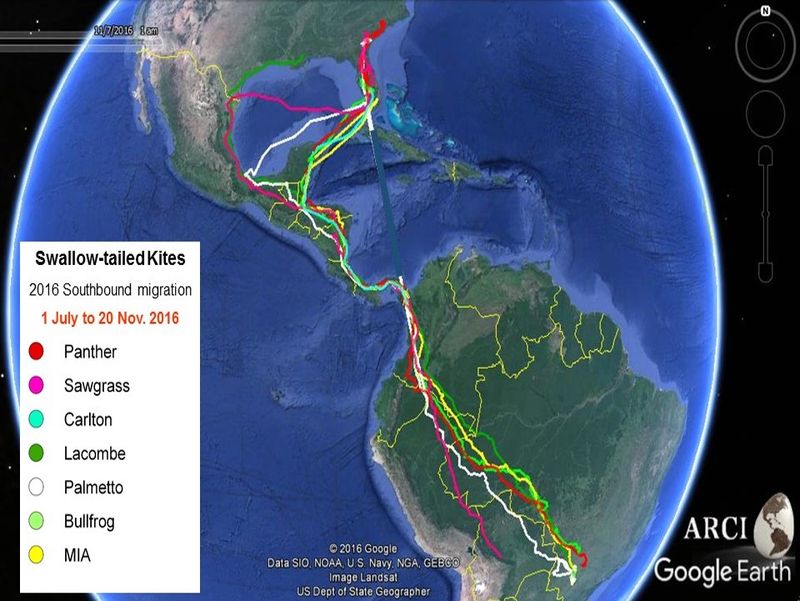
Once Florida’s kites lift off from their staging roosts, they face one of the longest migrations of any North American raptor. The one-way journey runs roughly 5,000 miles, though that figure is a general estimate and individual routes vary considerably.
Wintering areas lie in South America, with southern Brazil, Bolivia, and nearby regions identified as key destinations.
ARCI’s tracking program has followed individual birds from Florida all the way to South American wintering grounds, revealing that the route is far from a single fixed corridor. Some birds cross the Gulf of Mexico directly, while others travel through Cuba and the Florida Straits or work their way around the Gulf Coast before heading south through Mexico and Central America.
Central America serves as part of the travel path for many birds, not as a final destination. The U.S.
Fish and Wildlife Service species account places wintering areas in South America, consistent with what tracking technology has confirmed in recent decades. FWC also describes the roughly 5,000-mile one-way journey when discussing the significance of Florida roost sites as launching points for this trek.
The scale of the trip helps explain why the pre-migration period at communal roosts matters so much. A bird that leaves Florida underfueled faces a serious challenge across open water or over unfamiliar terrain.
The weeks spent feeding and resting at Florida staging areas are, in a real sense, the final preparation for a journey that dwarfs anything most backyard wildlife undertakes.
A quiet yard does not automatically mean a problem
Fewer kites overhead as September arrives is exactly what the normal annual cycle looks like from a Florida backyard. A sighting in late September, though, is not necessarily a sign that something went wrong.
The documented migration window extends into that month, and individual birds can pass through Florida or be detected after the main local population has already departed. One late bird does not mean migration has stalled or failed.
At the same time, a lack of sightings from a single yard provides weak evidence about what is happening more broadly. Swallow-tailed Kites fly high, spend much of the day over wetlands and wooded edges, and shift between foraging areas, communal roosts, and migration corridors.
Cornell Lab’s eBird data models seasonal movement patterns, but citizen-science sightings from any one location are not a complete count of how many birds remain in the state.
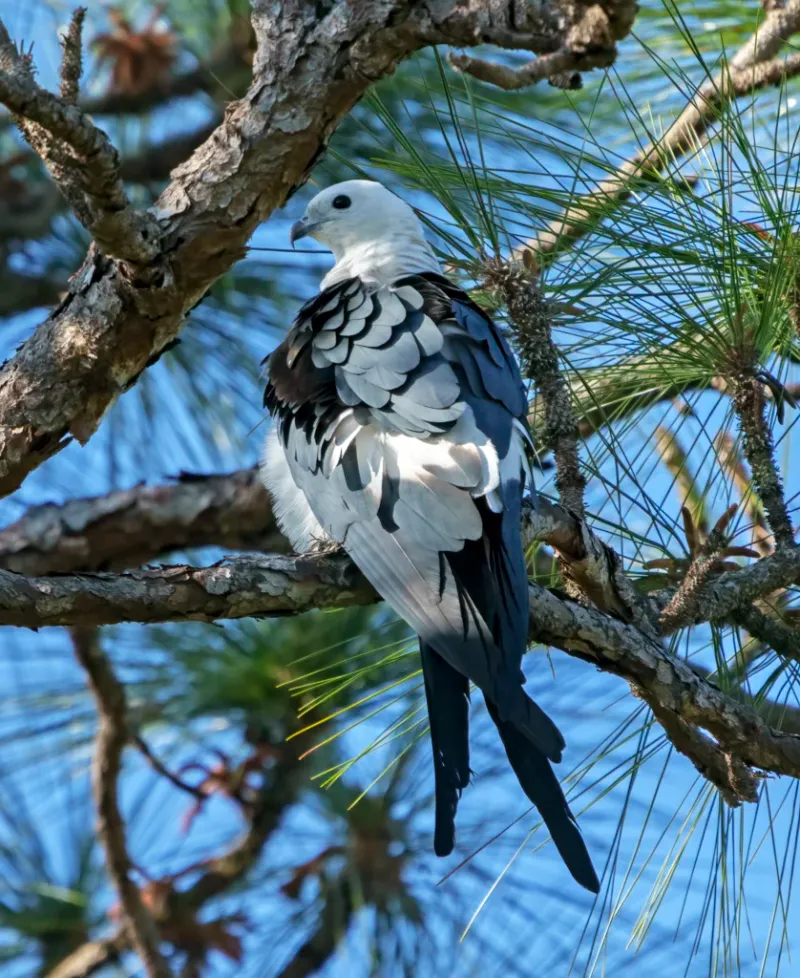
If a large, forked-tailed bird is still circling overhead and the identification is uncertain, a few field marks help. Adults carry a bright white head and underparts with dark wings and back, and that long, deeply forked tail is distinctive at almost any distance.
Cornell’s identification guide notes that the closest source of confusion is the Mississippi Kite, which appears mostly gray overall and has a shorter, squared-off tail rather than a fork. UF/IFAS Extension also highlights the forked tail as the single easiest feature to confirm from below.
One more Florida kite worth knowing: the Everglade Snail Kite is a completely different species. FWC states that Everglade Snail Kites do not migrate and instead move nomadically among Florida wetlands in response to habitat and prey conditions.
A kite seen over a freshwater marsh in October is far more likely to be a Snail Kite than a late-departing Swallow-tailed Kite.
Protect habitat without trying to summon migrating kites
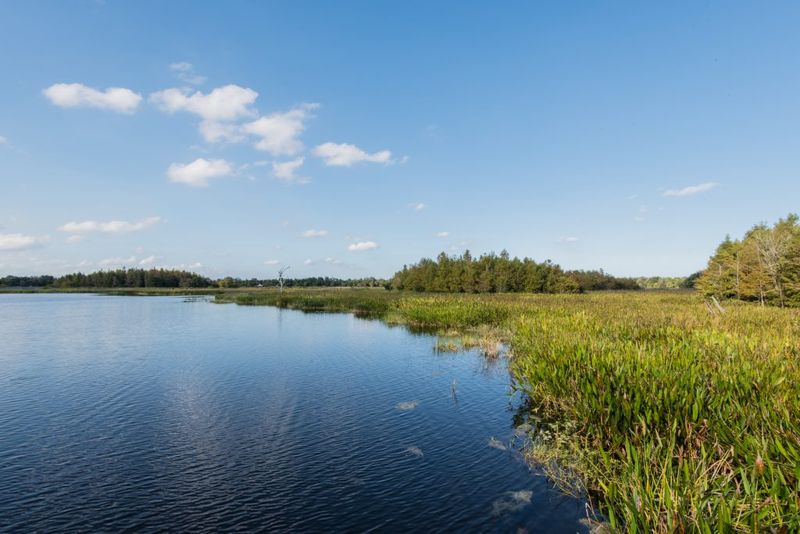
Homeowners who want to do something useful for Swallow-tailed Kites can focus on the habitat conditions the species genuinely depends on, rather than expecting a single yard feature to bring birds back on demand. The kites’ core needs operate at a landscape scale: mature trees tall enough for nesting, wetlands or open areas with abundant insect and small-animal prey, wooded edges that connect foraging territory, and safe staging and roosting sites.
FWC identifies habitat loss as the species’ primary long-term threat, so protecting trees and natural areas on private land has real value even when it does not produce an immediate kite sighting overhead.
Reducing unnecessary broad-spectrum pesticide use around wetlands and natural areas is another practical step. Audubon Florida notes pesticide use as a possible threat because it can reduce insect prey and affect food and water quality in areas the birds rely on.
This guidance applies to the broader landscape rather than implying that one yard’s choices directly caused a local disappearance.
Communal roost sites deserve particular care. Cornell notes that roosting kites are vulnerable to disturbance, and FWC describes disturbance as any action that alters wildlife feeding, breeding, resting, or sheltering behavior.
Keeping a respectful distance from roost trees, avoiding drones or low-flying aircraft in the vicinity, and not flushing birds from their perches all help birds conserve the energy they need for migration.
Active nests, eggs, and dependent young must not be removed or disturbed. The U.S.
Fish and Wildlife Service explains that most migratory bird nests are protected under the Migratory Bird Treaty Act, including nests that contain eggs or chicks. If an injured kite or a young bird is found on the ground, the right move is to contact a licensed wildlife rehabilitator rather than attempting to feed or treat it at home.
Audubon specifically recommends a licensed rehabilitator for injured or imperiled wildlife, since raptors require trained care that goes well beyond what most people can safely provide.
The emptying sky reflects an annual cycle
Fewer Swallow-tailed Kites overhead as summer ends is not a mystery or a warning sign. Many Florida birds are already well into their southbound migration by the time the September equinox arrives, with departures beginning as early as late July and continuing across a window that extends into fall.
FWC’s species account and ARCI tracking data both confirm that this broad departure window, not a single autumn date, defines when the kites leave.
A quiet yard is worth distinguishing from a genuine concern. Normal seasonal absence looks like a gradual thinning of sightings from late July onward.
A bird that appears injured, grounded, or unable to fly is a different situation that calls for contacting a licensed wildlife rehabilitator. An active nest with eggs or young that someone wants removed is a legal matter covered by the Migratory Bird Treaty Act.
Watching for the kites’ return in late February or early March, protecting the mature trees and wetland edges they depend on, and keeping a respectful distance from any roost or nest site are the most meaningful things a Florida homeowner can do. The sky will fill again, and knowing the rhythm behind the cycle makes the waiting part of the experience rather than a source of worry.