
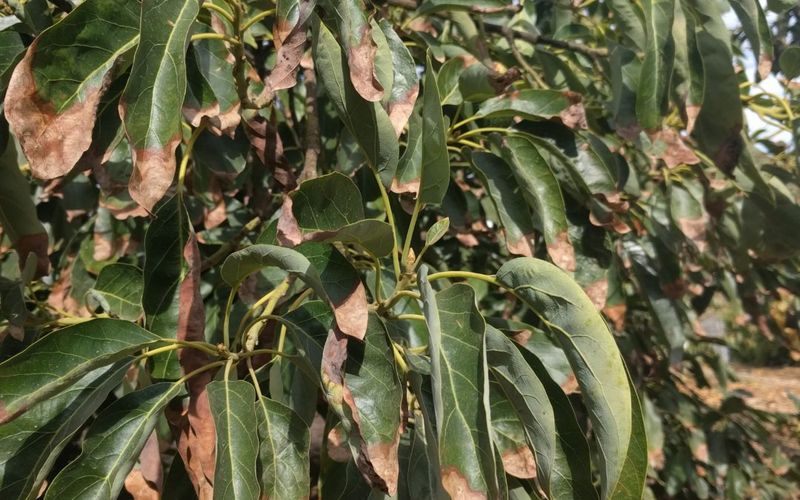
Crispy brown tips creeping along your avocado leaves in August or September are one of the most frustrating sights in a California backyard. The timing makes it easy to blame the heat, but the real explanation is often hiding in your soil and water supply.
Getting the diagnosis right matters, because the wrong fix can leave your tree worse off than before.
The Tip-First Pattern Suggests Salt Stress
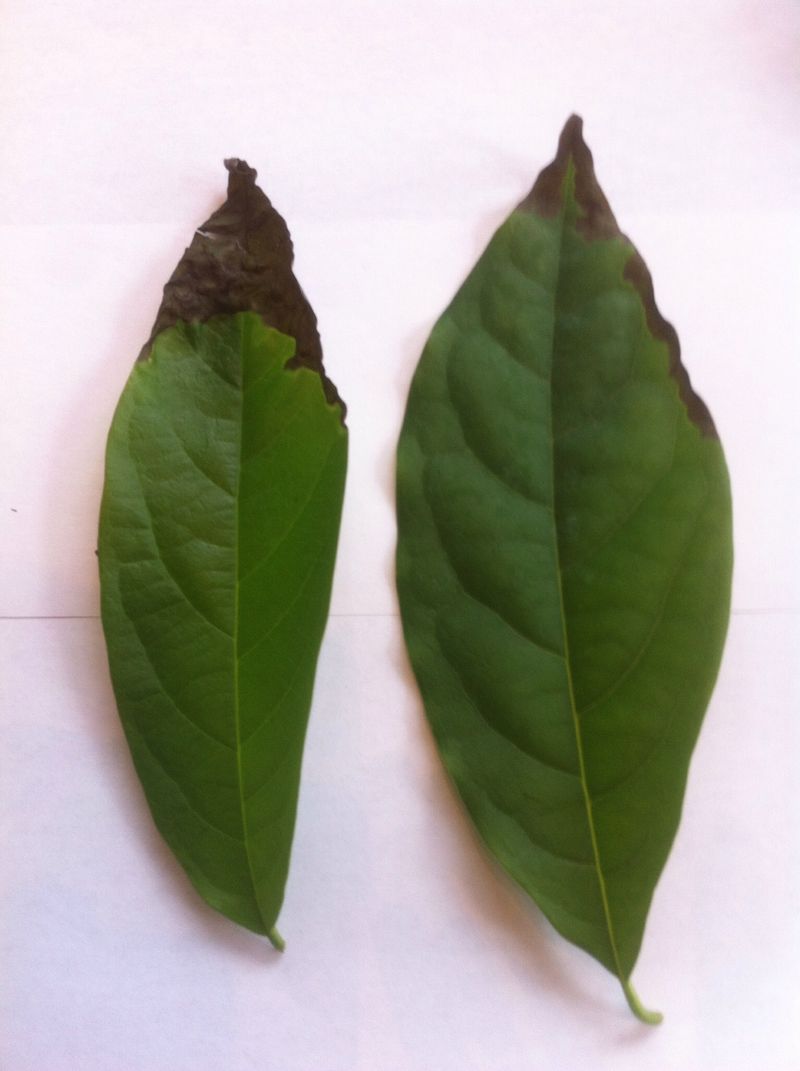
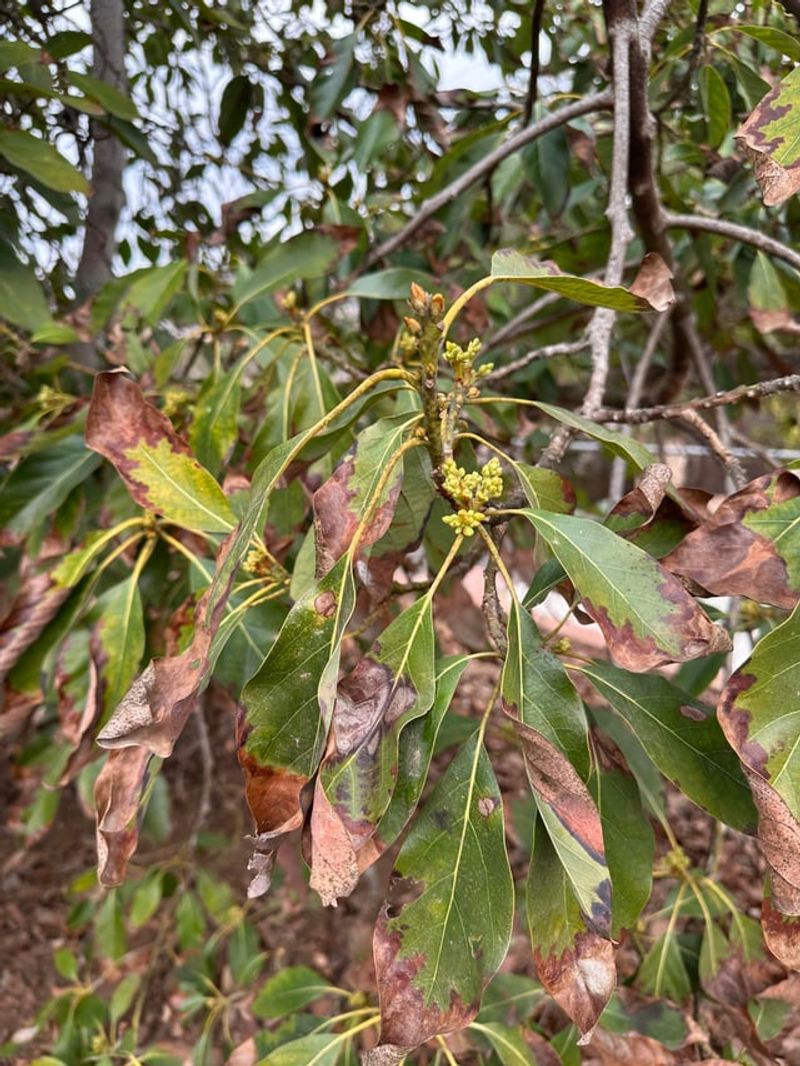
Browning that starts right at the pointed tip of an avocado leaf and then advances along both edges is a recognizable pattern, and it points toward a specific kind of trouble. UC IPM’s mineral toxicity guide for avocado identifies chloride and sodium toxicity as major causes of this tip-and-margin necrosis, where the tissue dies in a clean, progressive line rather than appearing as scattered spots or blotches.
Older, mature leaves tend to show the damage first, because the tree has been moving water and dissolved minerals through those leaves longest.
Salt injury happens when chloride or sodium accumulates in the root zone and eventually reaches concentrations that damage leaf tissue. Sources of that salt buildup include irrigation water that already carries dissolved minerals, watering that is too shallow or infrequent to move salts below the root zone, long dry periods without enough rainfall to flush the soil, and fertilizers, manure, or composts that add soluble salts.
UC research on leaf burn in avocado notes that avocados are particularly sensitive to both salt and drought stress compared with many other fruit trees, which helps explain why even moderate salt levels can produce visible symptoms.
Premature leaf drop can follow the browning, especially when the stress continues. If the same pattern reappears each summer, that recurrence can reflect a repeated or unresolved problem in the irrigation schedule, water quality, soil drainage, or root zone, though the timing alone does not confirm any single cause.
The tip-first, margin-advancing pattern is a useful clue, but it is a starting point for investigation rather than a firm diagnosis. Soil and water testing, not visual inspection alone, are what move a suspicion toward a reliable answer.
Why Late-Summer Heat Can Intensify the Browning
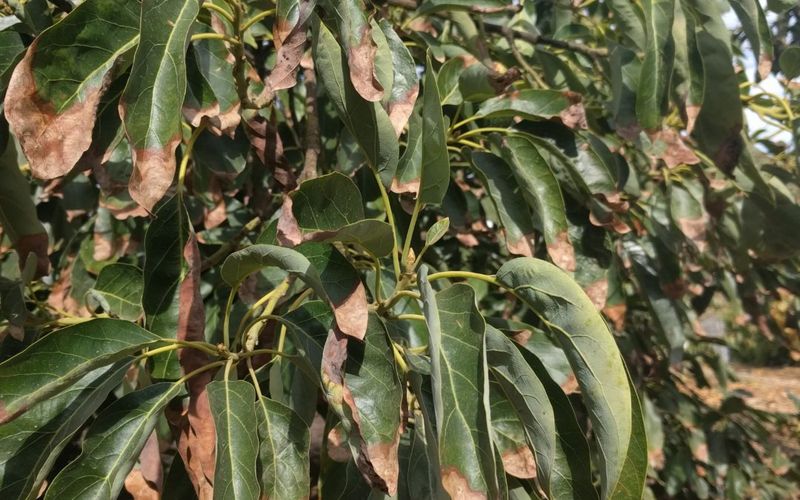
August and September push California avocado trees hard. Rainfall is essentially zero across most of the state, soil moisture drops steadily between irrigation cycles, and high temperatures increase the amount of water a tree needs to stay functional.
UC ANR’s drought guidance for avocados makes clear that avocados are among the most drought-sensitive of California’s common fruit trees, with shallow root systems that cannot draw on deep soil moisture the way deeper-rooted trees can.
Heat by itself does not cause the crispy brown tip pattern. What heat does is accelerate the conditions that concentrate salts.
As the soil dries between waterings, dissolved minerals become more concentrated in the remaining moisture, and the tree pulls in proportionally more salt with every drink it takes. Shallow or infrequent irrigation can make this worse by wetting only the top few inches of soil, which leaves accumulated salts sitting right where the roots are most active instead of moving them deeper.
Drought stress and salt stress are related but not identical, and separating them matters for treatment. Salt raises the difficulty of water uptake at the root level, so a tree growing in saline soil can look drought-stressed even when the soil is not completely dry.
UC ANR’s avocados and water resource explains this overlap clearly, noting that the two stresses can compound each other. On the other side, a tree that has simply been underwatered can develop brown tips without any meaningful salt problem at all.
Seasonal timing is a useful context clue, but it is not enough on its own to tell you which problem you are actually dealing with. UC ANR’s drought-or-root-rot guide reinforces that point: similar symptoms can have very different causes, and the calendar does not resolve the question.
Several Other Problems Mimic Brown Tips
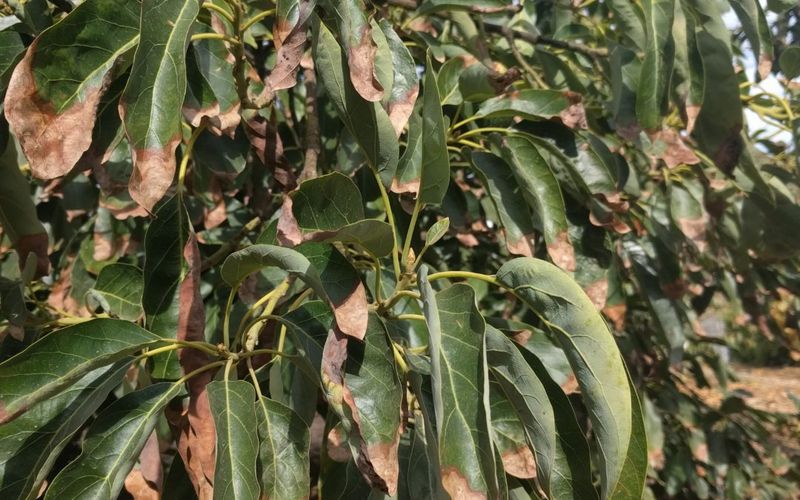
Before assuming salt injury, run through a quick visual triage. The pattern, position, and context of the browning can help you separate several problems that look similar at first glance, even if they cannot give you a definitive answer on their own.
Phytophthora root rot is one of the most important lookalikes to rule out, because the response to root rot is almost the opposite of the response to salt buildup. UC IPM’s root rot guide describes a constellation of signs: leaves that are small, pale, and wilted rather than a normal size with brown edges; a canopy that is visibly thinning; new growth that is sparse or stunted; and roots that are black, brittle, or simply missing when you gently probe the soil near the drip line.
A tree with those signs and a persistently wet or poorly drained site is raising a root rot flag, not a salt flag. Giving that tree more water can accelerate the disease.
Sunburn produces a different picture entirely. UC IPM’s sunburn page describes the damage as chlorotic-to-necrotic blotches on foliage, bark, or fruit that faces south or southwest, often worsened when canopy loss exposes previously shaded surfaces.
The damage is concentrated on exposed sides of the tree rather than uniformly distributed across older leaves.
Mite damage is worth checking separately because it requires a different response. Persea mites produce discrete circular brown or chlorotic spots, usually on the lower leaf surface, often accompanied by fine webbing.
Avocado brown mites feed mainly on upper surfaces and cause bronzing or a scorched look rather than the clean, margin-first necrosis associated with salt. Mite populations tend to rise in dusty, stressed trees, so a tree already struggling with heat or water issues may attract both problems at once.
Leaf position and canopy exposure help narrow the list. Salt injury tends to appear broadly across older leaves throughout the canopy.
Sunburn concentrates on sun-facing surfaces. Root rot spreads through the canopy as a general decline.
Mites cluster where you can find them with a hand lens on the leaf underside. None of these clues replace testing, but they help you decide which direction to look first.
Start With the Water, Soil, and Root Zone
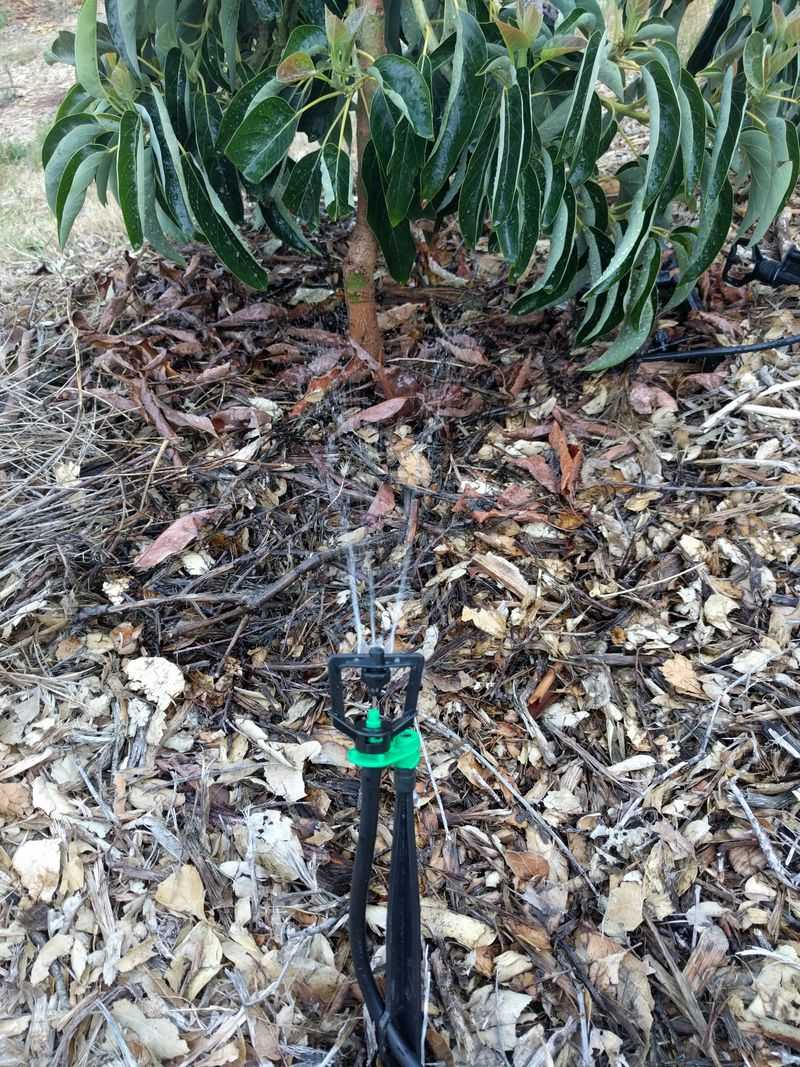
A systematic inspection of your water supply, soil condition, and root zone will tell you far more than studying the leaves. Start below the surface: push a screwdriver, soil probe, or your finger several inches into the ground beneath the outer edge of the canopy, where the feeder roots are most active.
Avocado roots are shallow, and the active zone often sits in the top twelve to eighteen inches of soil. If the soil at that depth is bone dry between waterings, the tree is not getting enough moisture to move salts through and out of the root zone.
UC IPM’s irrigation management guide for avocado recommends checking soil moisture before each irrigation cycle rather than running on a fixed timer schedule, because soil drying rates change with temperature, tree size, and season. Look at how the water is being applied as well.
Sprinklers that wet the trunk, emitters concentrated too close to the base, or a system with obvious runoff may be wetting the wrong zone or losing water before it reaches the feeder roots.
Testing your irrigation water is a step many homeowners skip, but it matters here. UC Cooperative Extension guidance on reading water quality reports explains what to look for: overall salinity measured as electrical conductivity, plus specific ions including chloride, sodium, boron, and nitrogen.
UC IPM recommends testing at least annually. Municipal water quality varies significantly across California, and well water can carry high mineral loads that build up over a season of irrigation.
Consider the site context while you are out there. UC Master Gardeners of San Luis Obispo County note that fertilizers, manure, and mushroom compost can all contribute soluble salts to the root zone.
A tree near a pool, a frequently salted driveway, a road with runoff, or an ocean-facing exposure may be receiving salt from sources beyond the irrigation water. UC ANR research on managing salinity for avocado production confirms that multiple salt sources can combine, making it important to account for the full picture of what is entering the root zone before deciding on a response.
Correct Irrigation Without Creating Root Rot
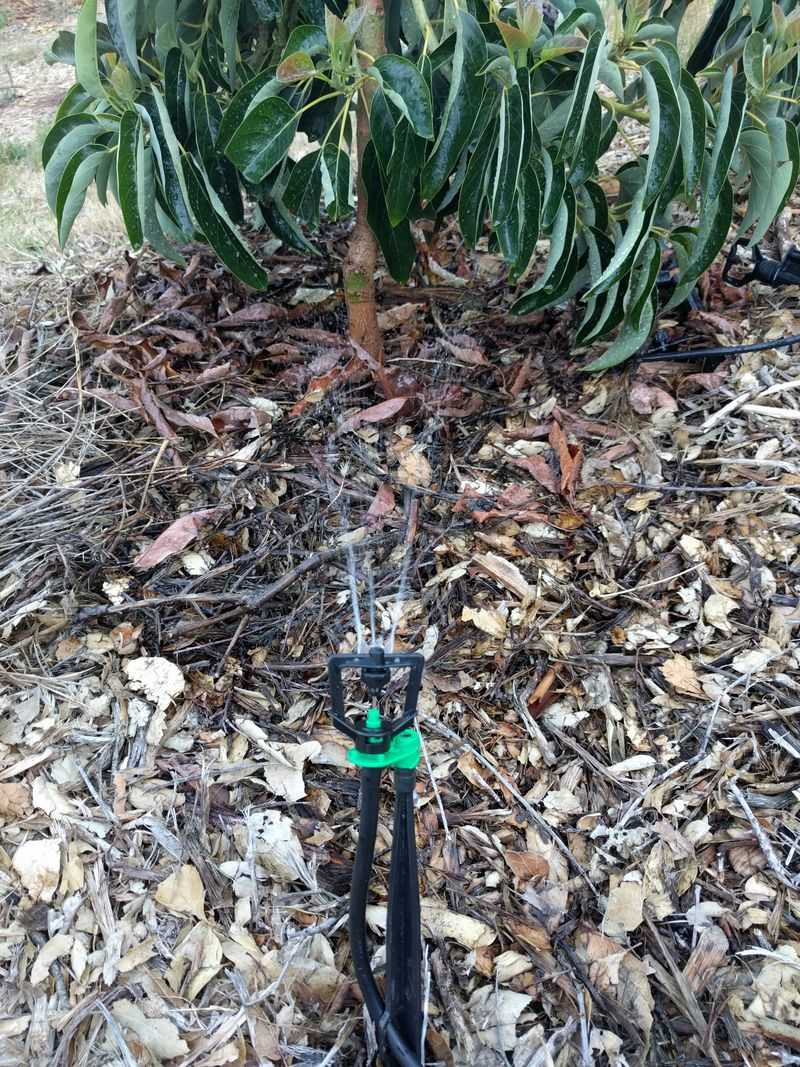
Once you have reason to suspect a watering imbalance or salt accumulation, the goal is to adjust irrigation so it thoroughly wets the active root zone and allows the soil to drain, without swinging into waterlogging. Those two risks pull in opposite directions, and managing both at once is the practical challenge.
UC IPM’s avocado irrigation guidance is direct about what to avoid: do not water soil that is already wet, do not allow water to sit against the trunk, avoid prolonged saturation, and design or adjust the system to minimize runoff. Avocados are highly susceptible to Phytophthora root rot, and excess soil moisture is the primary driver of that disease.
Checking soil moisture before each irrigation cycle, rather than running on a fixed schedule, helps keep the root zone in the range where water is available but not stagnant.
If salinity is confirmed or strongly suspected through water or soil testing, leaching can move accumulated chloride and sodium below the root zone. UC ANR’s avocados and salts resource explains that leaching works by applying enough water to push dissolved salts past the depth where roots are actively feeding.
The critical qualifier is drainage: leaching on a site with clay soil, a hardpan layer, or a high water table will not move salts downward effectively and may simply create the waterlogged conditions that favor root rot.
UC ANR’s salinity management research also notes that the quality of leaching water matters. Using saline water to leach salts may add as much mineral load as it removes.
Local water restrictions in California can also limit how much extra water is available, making it important to check current guidelines before planning a leaching cycle.
There is no universal answer for how long to run water during a leaching event. Duration depends on soil texture, drainage rate, emitter output, slope, tree age, and site conditions.
UC IPM’s root rot guidance underscores why this matters: if drainage is poor or the soil is already wet, extra water does not help and can actively harm the tree. Treat any leaching attempt as a site-specific decision rather than a standard prescription.
Avoid Fixes That Can Worsen the Problem
When leaves turn brown, the impulse to do something immediately is understandable. A few common responses, though, can push a struggling avocado tree in the wrong direction.
Adding fertilizer, manure, or compost is a frequent first instinct when foliage looks poor, but it is not automatically helpful here. UC Master Gardeners of San Luis Obispo County list excessive fertilizer, fresh manure, and mushroom compost as possible contributors to salt buildup in the root zone.
If the browning is already related to elevated salinity, adding more soluble material makes the problem worse rather than better. UC IPM’s avocado brown mite guidance also notes that excessive nitrogen can worsen certain mite problems, adding another reason not to fertilize reflexively when the diagnosis is unclear.
Spraying the foliage with water or any foliar product is not an established treatment for salt accumulation in the root zone. A strong water spray can help knock dust off leaves and may modestly reduce mite pressure on small trees, but it does not remove salts that have already built up in leaf tissue or in the soil.
Foliar spraying should not substitute for checking water quality, testing soil salinity, and evaluating drainage. UC IPM’s irrigation resource is consistent on this point: the root zone is where the problem originates, and that is where any real correction has to happen.
On the pest side, reaching for a pesticide before identifying what is actually present can harm beneficial insects and predatory mites that help keep pest populations in check. Inspect leaf undersides with a hand lens and confirm what you are seeing before treating.
UC IPM’s Persea mite page describes what to look for: circular spots, webbing, and mite bodies on the lower leaf surface. Salt burn does not look like that, and a pesticide will not fix a salt problem.
Finally, resist the urge to prune off every brown leaf right away. UC ANR guidance on heat-damaged trees advises waiting until the full extent of damage is visible and new growth has started before removing foliage.
Leaves that still have some green tissue are still shading the branches and fruit below them, and removing that cover prematurely can expose bark and developing avocados to direct sun damage.
Match the Pattern to the Next Step
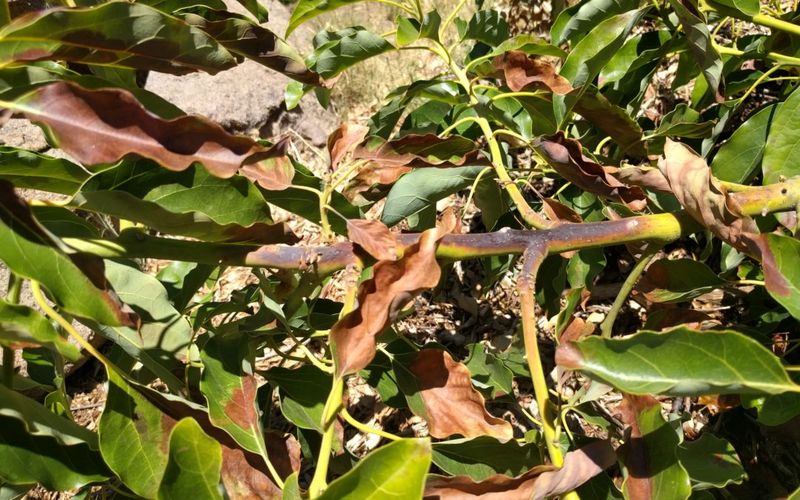
Putting the clues together points you toward a specific next action rather than a generic response. Tip-and-margin browning on older leaves, combined with dry soil between waterings or water that comes from a high-mineral source, is a reasonable signal to test your irrigation water and check soil salinity before doing anything else.
UC IPM’s mineral toxicity resource and UC IPM’s irrigation management guide both treat water quality and soil moisture monitoring as foundational steps, not afterthoughts.
If the soil stays wet, the canopy is thinning noticeably, new growth is sparse, or you find damaged roots when you probe near the drip line, the concern shifts toward root rot rather than salt. UC IPM’s root rot guide is the right reference for that path, and adding water is not the answer there.
Blotchy, chlorotic-to-necrotic patches concentrated on south- or southwest-facing foliage point toward sunburn, which calls for canopy protection rather than irrigation or salinity adjustments. Spots, bronzing, or webbing on leaf undersides call for pest identification before any treatment decision.
A California avocado tree needs balanced moisture, not the extremes of neglect or indiscriminate flooding. The most useful thing you can do with brown tips is treat them as a prompt to inspect, test, and understand the root zone rather than react to the symptom directly.
A tree that gets the right diagnosis has a real path forward; one that gets the wrong treatment often takes longer to recover than the original problem would have required.