
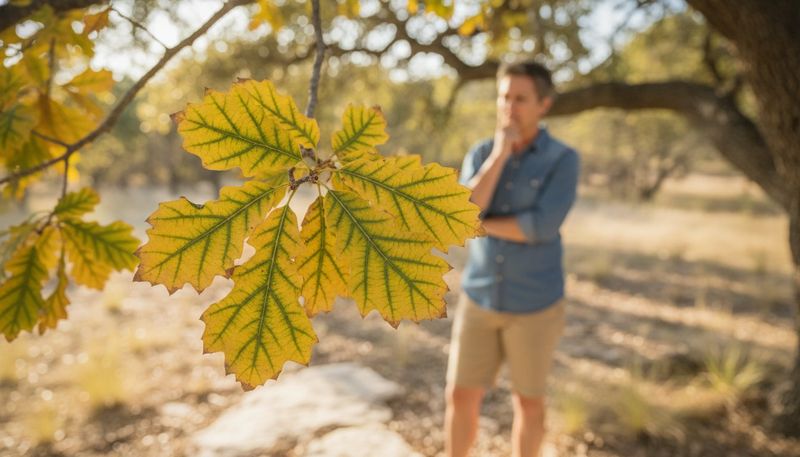
Pecan trees are a proud fixture across Central Texas yards, and watching one shed leaves ahead of schedule – or turn an unsettling shade of yellow in late summer – is enough to make any homeowner worry. A zinc shortage, sometimes called pecan rosette, is one real possibility worth investigating, but it is not the only explanation and not something you can confirm from leaf color alone.
Knowing what to look for on new growth, and how to separate zinc problems from disease, pests, and moisture stress, puts you in a much stronger position before the next growing season begins.
Zinc deficiency leaves a recognizable pattern on new growth
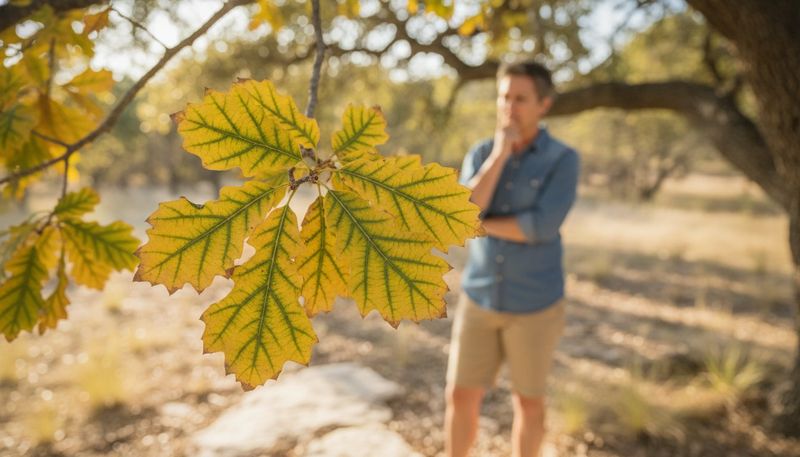
Pecan rosette has a signature look, and it shows up where the tree is actively growing, not deep in the older canopy. When zinc is genuinely short, the newest leaves at shoot tips tend to come out unusually small and narrow, with margins that curl, crinkle, or wave instead of lying flat.
Chlorosis – a pale yellowing between the leaf veins – often appears alongside that distorted shape, and the overall leaf color can take on a bronzed or washed-out tone that looks different from the deeper, more uniform yellow of nutrient or drought stress on older foliage.
Rosetting is one of the most telling signs. When shoot elongation slows down severely, multiple small leaves crowd together near the tip of a branch, forming a tight cluster instead of a normal, spaced-out arrangement along the stem.
Texas A&M’s pecan problem evaluation guide identifies small leaves, crinkled margins, bronzing, and rosetting as the more specific markers of zinc deficiency, rather than general canopy yellowing.
In advanced cases, shoot tips die back entirely, and repeated dieback over several seasons can leave branches looking stunted or stag-headed. UGA’s pecan nutritional disorders publication and UGA’s pecan fertility guide both note that reduced shoot elongation and terminal dieback accompany chlorosis and leaf distortion when zinc is consistently low.
The practical takeaway here is directional: walk out to the tree and look at the growth that emerged this season. Generalized yellowing across the whole canopy, especially on older interior leaves, is a nonspecific signal that could point to many different problems.
Several of the zinc-specific signs appearing together on new growth – small size, wavy margins, rosetting, bronzing – is what makes the deficiency genuinely plausible and worth pursuing further. Oklahoma State’s pecan disease guide similarly emphasizes that characteristic symptom clusters on new foliage are the meaningful starting point for a zinc diagnosis.
Yellow leaves and early drop do not settle the diagnosis
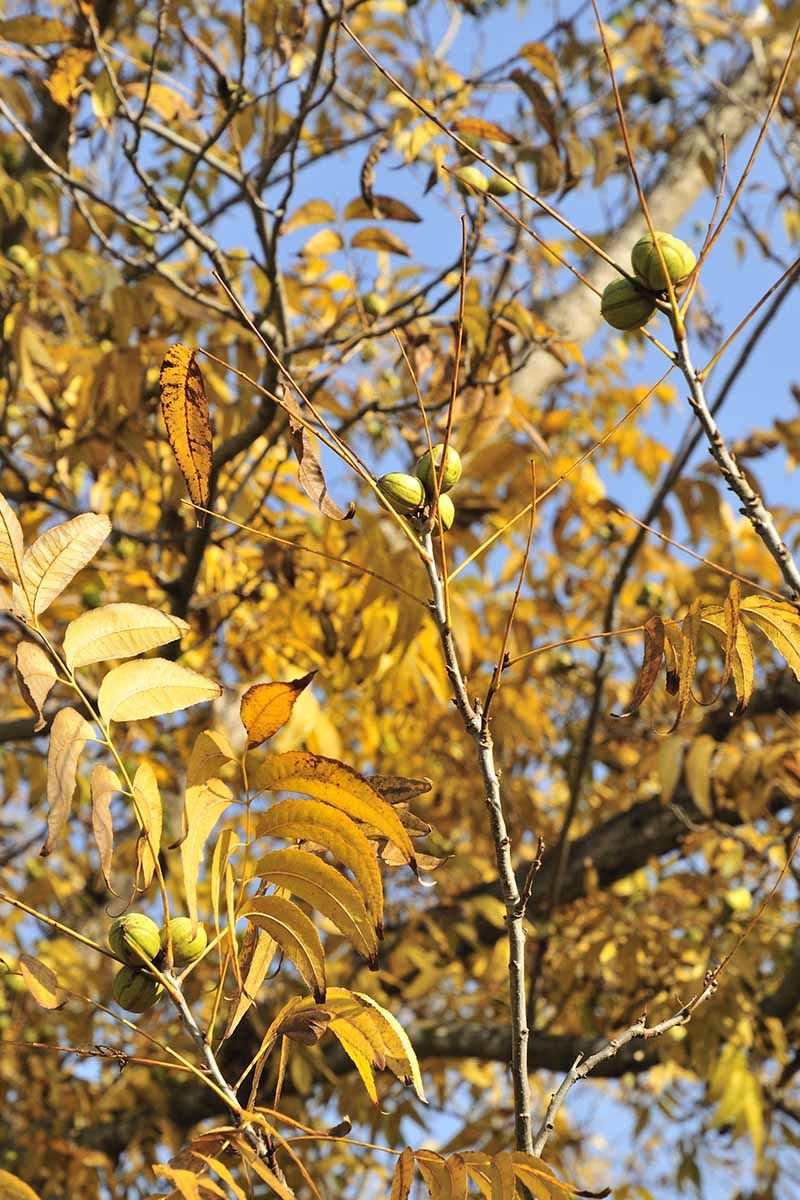
Yellowing leaves and early leaf drop are genuinely worrying symptoms, but they are not a zinc-deficiency fingerprint on their own. Many different problems can push a pecan into early defoliation, and treating zinc without identifying the actual cause wastes time and money while the real problem continues.
Texas A&M’s pecan evaluation resource specifically connects yellow leaves on young trees to root-growth problems and watering issues rather than to zinc shortage. The Pecan Tree publication from Texas A&M AgriLife notes that nitrogen deficiency can produce light-green or yellow foliage and premature leaf abscission, particularly on lower limbs – a pattern that is easy to confuse with zinc problems if you are only watching canopy color.
Generalized yellowing that starts on older, lower, or interior leaves is especially nonspecific. Drought and irregular watering, poor drainage, compacted soil, and root stress all reduce a pecan’s ability to move nutrients efficiently, which can cause yellowing that has nothing to do with a mineral shortage in the soil.
Pecan scab, pecan leaf scorch mites, black pecan aphids, and other foliar diseases can each trigger early leaf drop in Central Texas as well. The point is not that zinc deficiency is unlikely – it is a real and common disorder in Texas – but that yellowing and dropping leaves alone do not tell you which problem you are actually dealing with.
Oklahoma State’s home landscape pecan guide reinforces that fertilizers and nutrient corrections cannot compensate for moisture problems, disease pressure, or unsuitable site conditions. Work through the symptom pattern before reaching for any product.
Check scab, mites, and moisture stress before blaming nutrition
Before concluding that nutrition is responsible for what you are seeing, spend a few minutes doing a physical inspection of the tree. Three causes are especially worth ruling out for Central Texas pecans in late summer and early fall: pecan scab, pecan leaf scorch mites, and drought or moisture stress.
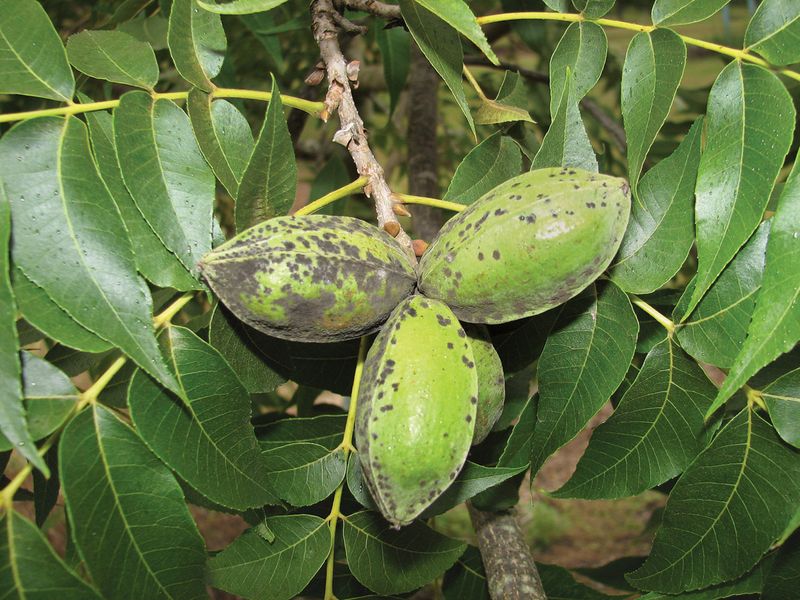
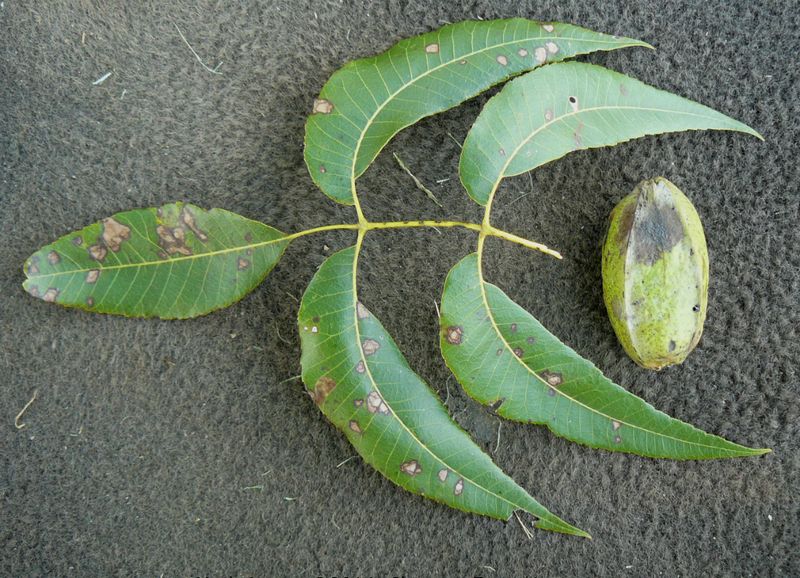
Scab is a fungal disease that produces small, olive-green to black spots on leaflets, twigs, shucks, and developing nuts. In wetter parts of Central Texas or during rainy seasons, scab infection can advance quickly and cause premature foliage drop that looks like a nutrient problem from a distance.
Texas A&M AgriLife’s pecan scab publication confirms that the disease can cause premature foliage loss and that severity varies with cultivar susceptibility, rainfall, humidity, and airflow. Not every tree in Central Texas will have scab – disease pressure is genuinely location-dependent – but if you see the characteristic dark spots on leaf surfaces, twigs, or shucks, that is a separate problem from zinc and needs a different response.
Mite damage looks different. Pecan leaf scorch mites tend to settle on the undersides of leaves, particularly on interior or shaded foliage, and produce stippling, fine russeting, or a scorched-looking browning that can spread across the leaf surface.
Texas A&M AgriLife Entomology’s pecan pest management guide reports that mite populations build under hot, dry conditions and are more damaging when trees are already under moisture stress – a situation that describes many Central Texas yards in August and September.
Moisture stress itself deserves its own check. A pecan that has been underwatered or inconsistently irrigated during summer will drop leaves early as a protective response, and that stress also makes the tree more vulnerable to mite outbreaks and less able to take up whatever nutrients are in the soil.
Texas A&M AgriLife’s home orchard pest guide notes that moisture-stressed trees are particularly susceptible to mite damage. Check the soil moisture at root depth before assuming a nutrient cause, and look at the undersides of leaves before assuming disease.
High-pH soil can make zinc unavailable
One of the more counterintuitive aspects of zinc deficiency in Texas pecans is that the problem is not always about how much zinc is in the soil. A tree can sit above soil that contains measurable zinc and still show deficiency symptoms because the chemistry of the soil prevents the roots from absorbing it.
Alkaline, calcareous, or high-pH soils, which are common across much of Central Texas’s limestone-based Hill Country terrain, bind zinc into forms that plant roots cannot easily access. UGA’s pecan nutritional disorders guide explains this distinction clearly, and UC IPM’s zinc deficiency resource reinforces that high soil pH is one of the primary reasons zinc becomes unavailable to trees even when soil levels are not technically depleted.
This is why soil-applied zinc is generally more useful on acidic soils, while foliar applications tend to be the preferred route in high-pH conditions.
Root problems and site conditions add another layer. Excess moisture, compacted soil, poor drainage, or physical root damage all reduce a tree’s ability to take up nutrients regardless of what the soil contains.
Oklahoma State’s home landscape pecan guide and Texas A&M’s commercial pecan orchards resource both note that site conditions and soil pH shape how much zinc a tree can realistically access.
Young trees and mature bearing trees may also respond differently to zinc programs, so a strategy that works for a 30-year-old pecan may not be appropriate for a tree planted three years ago. Soil and tissue testing gives you actual numbers to work with rather than a guess based on symptoms.
A visual diagnosis alone cannot tell you whether zinc is absent from the soil, present but chemically locked up, or simply unavailable because of root stress or site problems – and that distinction matters for choosing the right response.
The useful fall fix is investigation, not a rushed zinc spray
Fall is genuinely useful for pecan care, but not because it is the right time to spray zinc onto a tree that is already losing leaves. Foliar zinc uptake depends on leaves that are actively growing and not yet hardened off.
Spraying senescing foliage in October or November will not correct a deficiency or restore leaves that have already yellowed, and it may waste product while creating drift risk for nearby plants.
What fall does well is documentation. Walk the tree now and photograph the newest shoots and leaves you can still access.
Note whether the unusual symptoms, small leaves, wavy margins, rosetting, bronzing, or tip dieback, are concentrated on particular limbs or scattered across the whole canopy. Record which parts of the tree show the most yellowing and whether it started on new growth or older interior leaves.
That pattern will be genuinely useful when you talk to a local extension agent or plan spring care.
Managing soil moisture through the fall is also a practical and immediate step. Oklahoma State’s home landscape pecan guide emphasizes that trees need consistent moisture without waterlogging, and a pecan going into dormancy under drought stress is less prepared for a healthy spring flush.
Water deeply at the drip line if rainfall has been short, but avoid creating standing water or saturating the root zone.
Where scab is a concern, Texas A&M’s pecan scab guidance suggests removing and disposing of diseased fallen foliage to reduce the inoculum available for the following spring. That is a concrete fall action with a real effect on next season’s disease pressure.
If you want to pursue testing, fall is a reasonable time to submit a soil sample. Texas A&M’s plant tissue testing FAQ and UGA’s pecan nutrition publication both clarify that pecan leaf-tissue sampling has a specific timing window – generally July through early August – so leaf samples collected after fall drop will not give you reliable results.
Soil testing, however, can proceed and will give you baseline pH and nutrient data to interpret over winter.
Testing can show whether the tree is absorbing enough zinc
Visual symptoms give you a starting hypothesis, but a laboratory test gives you a number. Tissue testing is the most direct way to find out whether the pecan is actually absorbing enough zinc, and soil testing adds context about pH and background nutrient levels that can explain why a deficiency is occurring even when zinc is present in the ground.
Texas A&M’s Soil, Water and Forage Testing Laboratory accepts both soil and plant-tissue samples and provides results for soil nutrients, pH, and elemental concentrations in plant material. Their soil testing service and plant tissue testing FAQ explain submission procedures and what each test covers.
For Central Texas homeowners, this is the most accessible and regionally appropriate starting point.
Pecan leaf-tissue sampling has a specific timing window that matters for result reliability. UGA Extension’s tissue sampling timing guide and UGA’s pecan leaf sampling resource both identify approximately July 7 through August 7 as the stable sampling window, when leaf nutrient concentrations are most consistent and comparable to published standards.
Samples collected outside this window, including after fall defoliation, are less reliable and harder to interpret against established benchmarks.
UGA’s pecan nutritional disorders publication identifies approximately 50 parts per million as the lower end of the recommended leaf-tissue zinc range, with visible deficiency symptoms often appearing when tissue levels drop below about 40 ppm. Those reference points are useful context, but sample quality, tree age, cultivar, and how the local lab interprets results all affect how actionable a single number is.
A result in the borderline range is a reason to consult a local extension agent or certified arborist rather than an automatic trigger for treatment.
If this fall’s timing has already passed for leaf sampling, collect a soil sample now and mark your calendar for next July. That preparation alone puts you in a far better position than guessing from symptoms.
A supported zinc correction belongs in the next growth flush
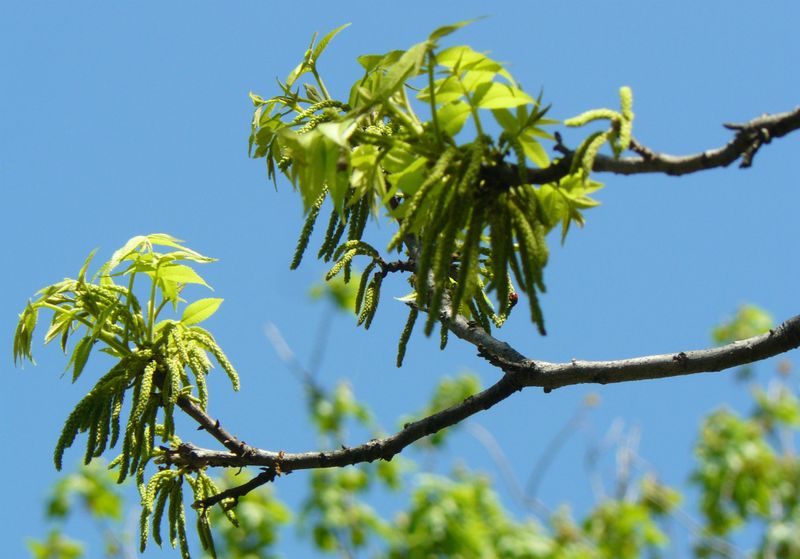
Once testing or a consistent symptom pattern makes zinc deficiency genuinely plausible, the timing of any corrective treatment matters as much as the product itself. Foliar zinc applications work best when leaves are young, actively growing, and still taking up nutrients efficiently.
That window opens at budbreak in spring and generally extends through early summer before the current season’s leaves fully harden off.
UGA’s pecan nutritional disorders guide and UGA’s pecan fertility resource both recommend beginning foliar zinc applications at budbreak and repeating according to label directions or local pecan recommendations. Oklahoma State’s April 2025 horticulture tips reinforce that spring shoot growth is the target period for effective zinc uptake in pecans.
For homeowners, the right starting point is the product label and a conversation with a local extension agent, not a commercial spray schedule designed for large orchards. Texas A&M AgriLife’s homeowner fruit and nut spray guide specifically cautions against exceeding label rates and warns that zinc sulfate drift can injure or kill zinc-sensitive plants nearby.
Rates and formulations designed for commercial operations with large spray volumes and professional equipment do not translate directly to a backyard tree, and applying more product than the label specifies will not speed recovery.
Excess zinc creates its own problems. Too much zinc in the soil or in plant tissue can interfere with the uptake of other nutrients, including copper and nickel, and can cause toxicity symptoms that look like a different deficiency entirely.
Texas A&M’s commercial pecan orchards resource notes the importance of following label directions and local guidance for this reason.
Correcting zinc deficiency supports healthier new growth in the season after treatment. Leaves that have already yellowed, distorted, or dropped will not recover from a zinc application, but a properly timed spring program gives the tree a real chance to put out stronger, fuller foliage in the following flush.
Use the symptom pattern to choose the next step
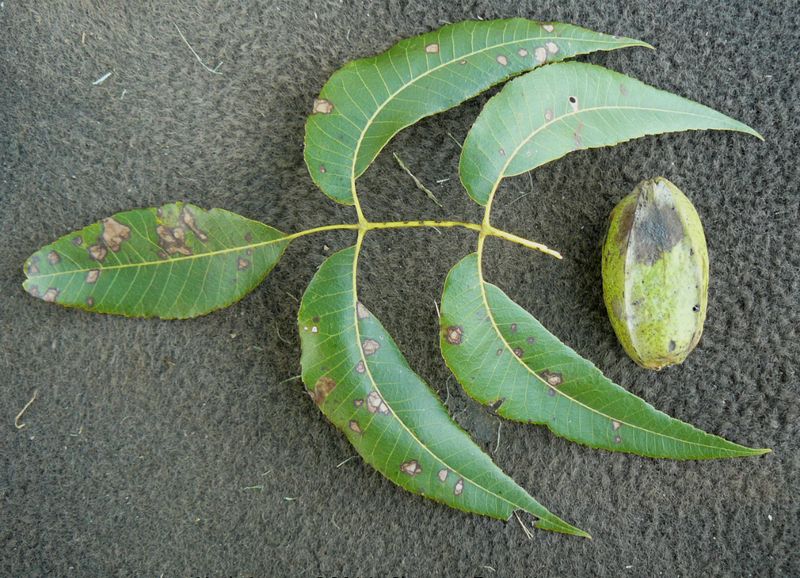
Putting this all together comes down to what you actually see on the tree. Zinc deficiency is a correctable possibility when small or narrow new leaves, wavy or crinkled margins, bronzing, rosetting, or reduced shoot growth appear alongside yellowing.
Those signs together on current-season growth make the deficiency worth investigating. Early leaf drop by itself, especially from older or lower leaves, requires a broader look before any nutrient correction makes sense.
A practical sequence for right now: start at the newest growth and look for the characteristic zinc signs rather than just canopy color. Check leaf undersides and twig surfaces for mite stippling or scab’s olive-to-black spots.
Confirm that soil moisture has been adequate and consistent. Photograph and document what you find, noting which parts of the tree are affected.
Submit a soil sample to Texas A&M’s testing lab if you have not already, and set a reminder to collect leaf tissue samples next July. Reserve any zinc application for a properly timed, label-directed program at spring budbreak, supported by Texas A&M’s pecan problem evaluation guidance or a local extension recommendation.
And consider UGA’s pecan nutritional disorders resource for additional context on what tissue results mean in practice.
A pecan that gets an accurate diagnosis this fall has a much better chance of a strong spring than one that gets an untested treatment applied at the wrong time of year.