
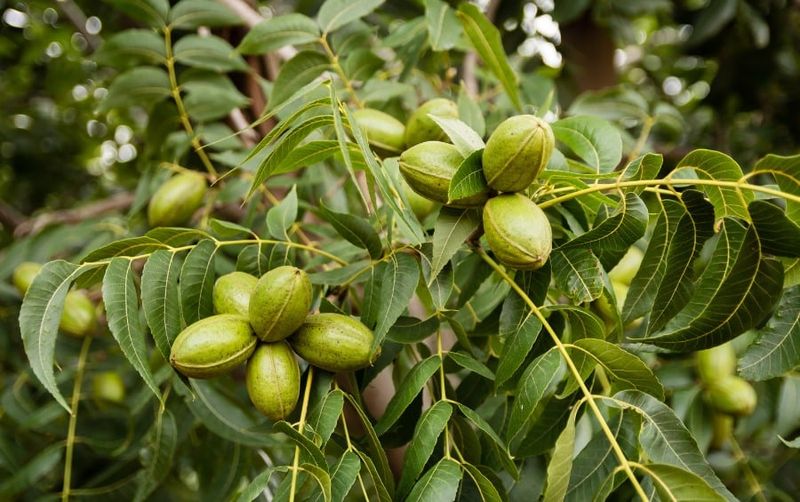
Watching half-formed pecans hit the ground before they ever fill out is one of the more frustrating things a Central Texas grower can experience. Drought stress and a heavy crop load are common reasons a tree sheds nuts it cannot finish, but those are not the only possibilities.
This guide walks through how to inspect what is dropping, check what the soil is actually doing, and respond in a way that supports the nuts still on the tree without making things worse.
Fall drop can signal a water-and-crop-load squeeze
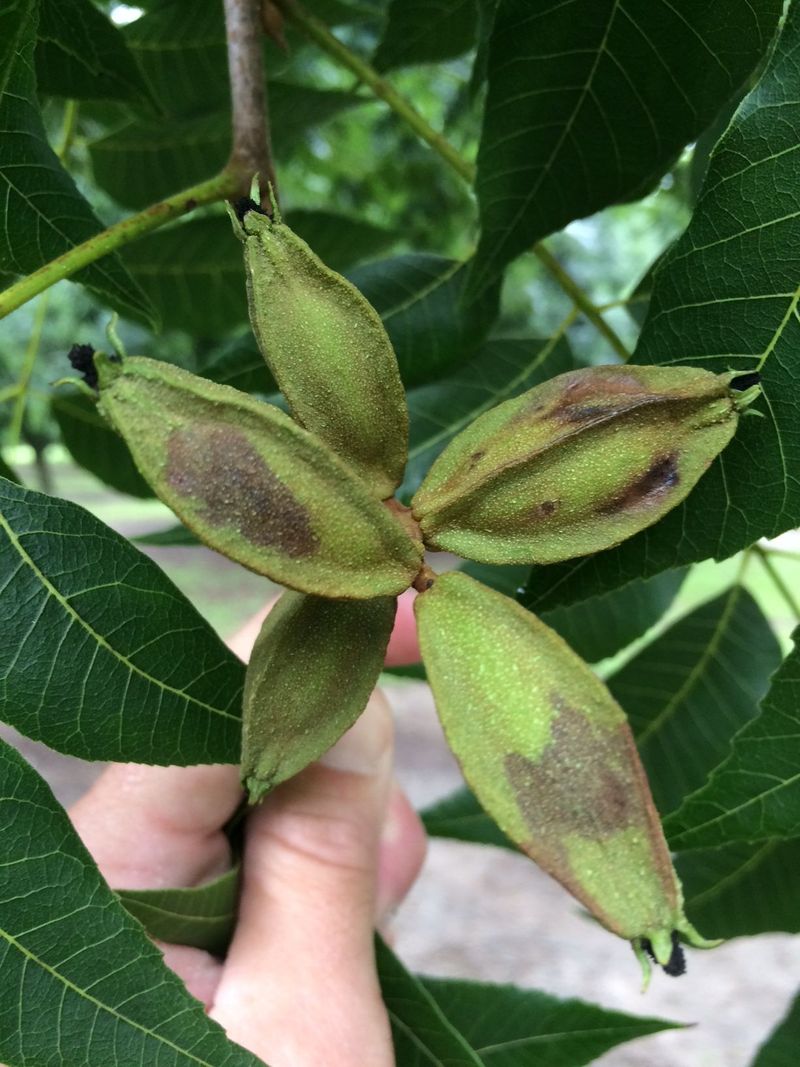
Pecan trees in Central Texas can drop significant numbers of half-formed nuts in late summer and early fall, and inadequate soil moisture during kernel filling is one of the more common contributing factors. When a tree carries a heavy crop at the same time water supply runs short, the nuts compete intensely for both water and carbohydrates.
Texas A&M’s pecan problem evaluation guidance describes drought without irrigation as a cause of kernels with air centers and fuzz, and identifies poorly filled, wafer-like kernels as linked to soil conditions, heavy crop loads, and management gaps.
A heavy crop amplifies that pressure. When more nuts are competing for a limited supply of water and stored carbohydrates than the tree can support, some nuts simply do not finish.
Oklahoma State’s crop-load management guidance explains that excessive crop loads reduce nut size, kernel percentage, and the following year’s production – all of which begin with the tree being unable to fill every nut it set.
Here is the important qualification: fall drop alone cannot confirm that drought or crop overload is the cause. UGA Pecan Extension’s late-summer nut drop overview explains that pecans go through several natural physiological drop periods tied to pollination quality, endosperm development, and embryo formation – some annual loss is entirely normal.
Insects, disease, poor pollination, water-split, and drainage problems can all produce symptoms that look similar to stress-related drop.
Use this article as a diagnostic framework, not a guaranteed explanation. The goal is to inspect what is actually happening on your tree and in your soil before deciding what to do next.
Treating every dropped nut as a drought problem risks missing a different issue entirely, and it can lead to watering responses that do more harm than good in poorly drained yards.
Why summer moisture deficits show up during fall filling
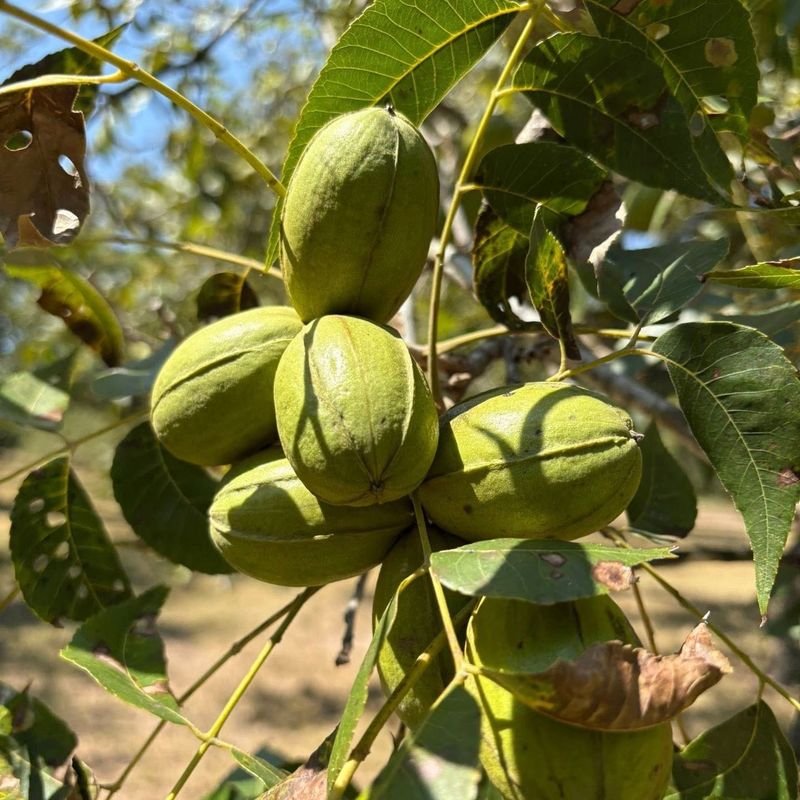
Kernel filling in pecans is one of the most water-intensive stages of the entire growing season. University of Georgia’s pecan irrigation guidance identifies August and September as peak water-demand months, while Oklahoma State places the critical window from August through October depending on cultivar and location.
The exact timing shifts with variety, rainfall, heat, and how far along a given tree is in its development cycle – so Central Texas growers should treat those dates as a range rather than a fixed calendar.
What makes this tricky is that a symptom you see in September or October may have started months earlier. Moisture stress during nut sizing in June or July can produce small nuts and shell-hardening problems before kernel filling even begins.
By the time the tree is trying to fill those kernels in late summer, it is already working with a compromised foundation. Texas A&M’s water-use guidance supports the connection between uneven or inadequate soil moisture and reduced nut quality, noting that deep, consistent watering around the dripline matters more than surface-level sprinkling.
A heavy crop load intensifies the problem by spreading whatever water and carbohydrates the tree can access across a larger number of developing nuts. Oklahoma State’s home landscape pecan management fact sheet notes that trees under water stress are more likely to drop nuts or produce only partially filled kernels, especially when crop load is high.
Watering now can still make a difference for nuts that remain on the tree and have not yet aborted. But steady moisture going forward cannot undo damage that accumulated over a summer of inadequate water.
Kernels that already aborted will not refill, and nuts the tree has already released will not reattach. The value of acting now is in supporting what is still developing, not recovering what is already lost.
Inspect fallen nuts before diagnosing drought
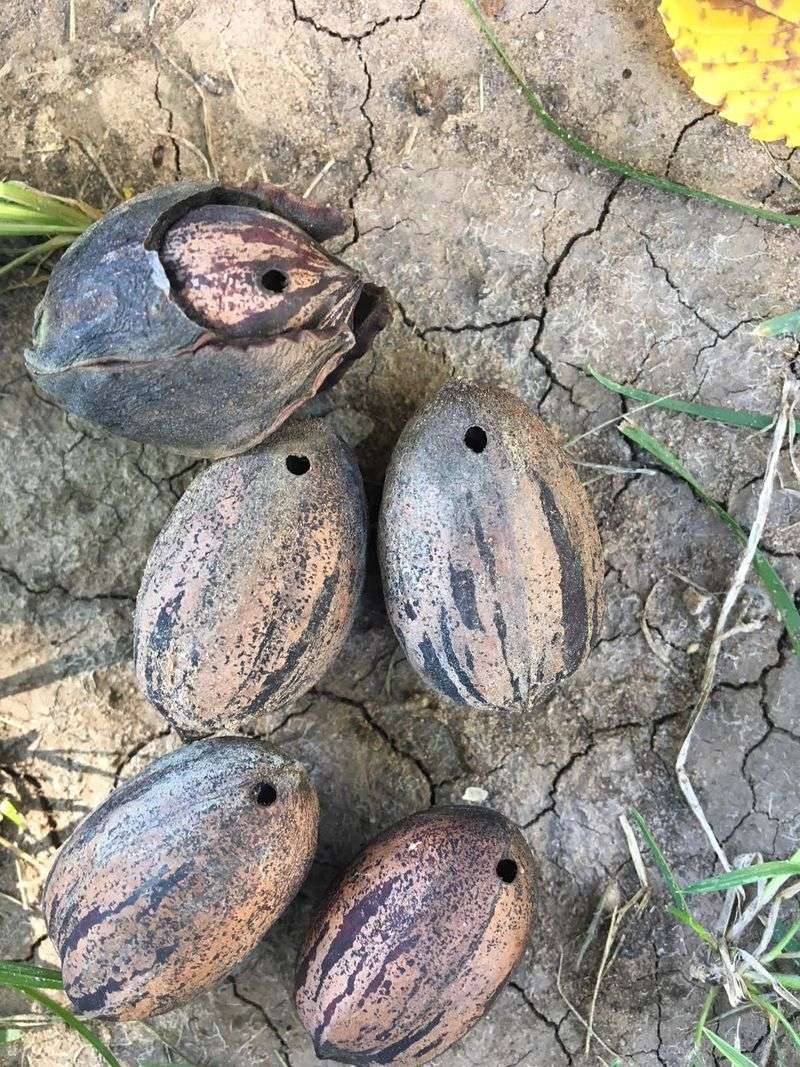
Before drawing any conclusions about why nuts are dropping, pick up a handful and look at them carefully. What you find on the outside – and inside – can help you narrow down whether you are dealing with stress-related drop, natural physiological loss, or something that needs a more targeted response.
Visual inspection is not a definitive diagnosis, but it is the most useful first step available to a homeowner without lab equipment.
Start by looking for punctures. A small, dark entry hole in the shuck or shell, sometimes accompanied by brown ooze or a sticky residue, raises concern about pecan weevil.
Oklahoma State’s pecan weevil emergence alert notes that weevils puncture nuts during the water stage, which can cause them to fall before the kernel develops. Larval tunnels, exit holes, or a partially consumed kernel inside a fallen nut also point toward insect involvement rather than pure moisture stress.
Black stains on the shuck or shell can suggest fungal disease. Shucks that remain tightly attached to a fallen nut, rather than beginning to split naturally, may indicate the nut aborted early rather than matured normally.
Texas A&M AgriLife’s pecan pest guide for home orchards and Oklahoma State’s home landscape fact sheet both describe these visual clues as indicators worth investigating rather than proof of a single cause.
A nut with no visible feeding damage, no staining, and a clean but underdeveloped kernel fits the profile of physiological drop or stress-related abortion more closely – but even that is not certain. UGA Pecan Extension points out that some drop is completely normal across multiple developmental stages, and that heavy drop does not automatically prove drought, crop overload, or pest activity.
Collect several nuts from different parts of the tree rather than drawing conclusions from one or two, and note whether the drop is concentrated under certain branches or spread evenly across the canopy.
Check soil moisture and drainage across the root zone
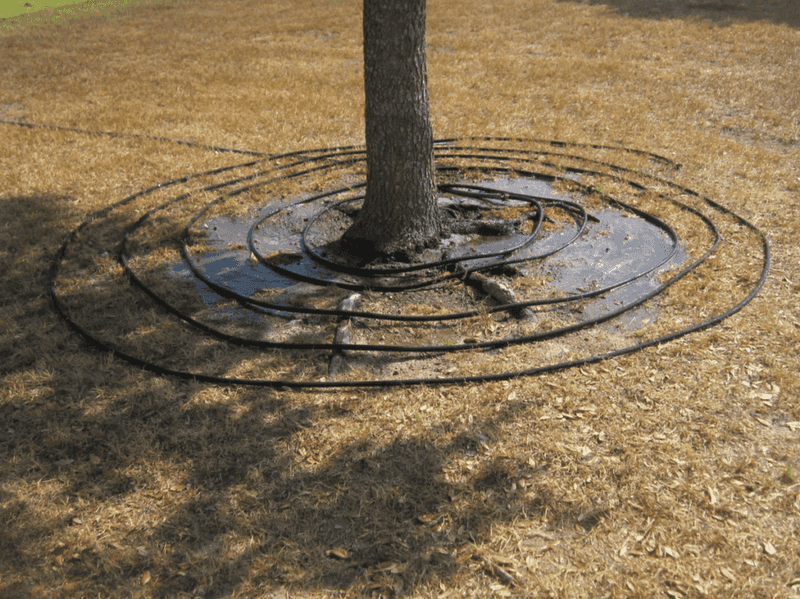
Confirming that your tree actually needs water before you start irrigating is a step many homeowners skip, and skipping it can lead to problems that are just as damaging as drought. Surface soil in Central Texas clay can look bone-dry while the soil six to eight inches down still holds adequate moisture.
Push a screwdriver, a soil probe, or a long stick into the ground near the dripline and check what you find. If it slides in easily and comes out damp, the root zone may not be as dry as the cracked surface suggests.
Texas A&M’s water-use guidance emphasizes that mature pecan roots are not confined to a small area around the trunk. They extend outward well beyond the canopy edge, which means checking moisture only near the base of the tree gives you an incomplete picture.
Sample the soil at multiple points along and inside the dripline for a more accurate read.
Also look for signs that point the opposite direction. Standing water after rain, yellowing leaves without obvious pest damage, soft or spongy soil, and declining vigor in branches can all indicate drainage problems or root decline rather than simple under-watering.
Texas A&M’s pecan problem evaluation guide notes that poorly drained soil and root problems can produce symptoms that overlap with drought stress, making a soil check essential before adding more water.
Grass growing under the tree is another factor worth noting. Texas A&M’s improved pecan crop guide notes that turf competition increases the tree’s overall water demand, meaning a tree surrounded by lawn may need more consistent irrigation than one with bare or mulched soil beneath it.
If your soil check confirms dry conditions at depth, that is a reasonable signal to water. If the soil is already moist or wet, additional irrigation is unlikely to help and may actively harm the root zone.
Restore steady moisture without flooding the tree
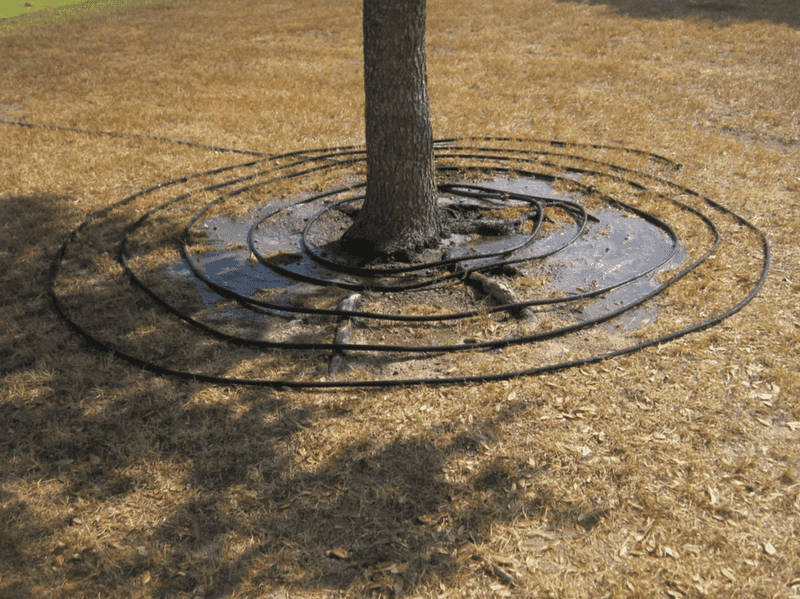
Once you have confirmed that the soil is genuinely dry at depth, the right response is a slow, deep soaking applied across as much of the root zone as practical – not a quick spray at the trunk. The goal is to move water down through the soil profile where the feeder roots can actually reach it.
Running a sprinkler briefly at the base of the tree for twenty minutes does not accomplish this in Central Texas clay or rocky soils.
Texas A&M’s irrigation guidance recommends slow watering under the dripline and warns explicitly that excessive water can displace oxygen from the root zone and damage roots. Flooding the area or running irrigation continuously on saturated soil creates a different kind of stress, and in clay-heavy Central Texas soils that drain slowly, that risk is real.
Aim for thorough, not excessive.
A commonly cited planning benchmark for bearing pecan trees during the growing season is roughly one to two inches of water per week, counting both rainfall and irrigation combined. UGA’s pecan irrigation guide and Oklahoma State’s home landscape fact sheet both reference this range as a general growing-season planning guide.
Treat it as a starting point, not a precise prescription. Soil type, tree size, canopy cover, drainage, and local water restrictions all require adjustment, and what works on a sandy loam in Georgia may behave very differently in Central Texas caliche or clay.
UGA’s pecan irrigation overview advises pausing irrigation after significant rainfall and not continuing a fixed schedule when soil remains saturated. Check the soil before each irrigation cycle rather than running on a rigid calendar.
If recent rain has kept the root zone moist, skip the scheduled run. If a hot, dry stretch has pulled moisture out faster than expected, adjust accordingly.
Consistent, responsive watering supports the nuts still developing on the tree; automatic, unmonitored irrigation does not.
A heavy crop creates a management problem for next season
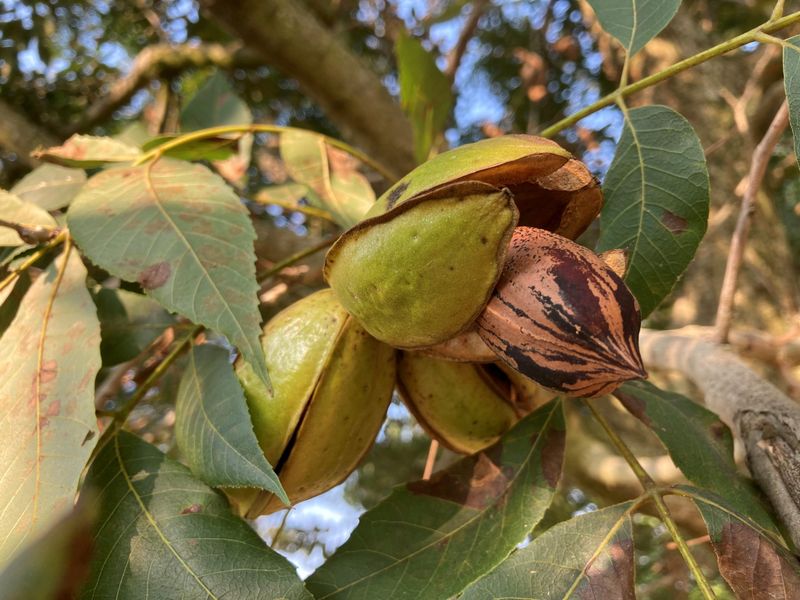
A pecan tree that sets more nuts than it can fill is not just sacrificing this year’s crop quality – it is also borrowing against next year. Heavy crop loads deplete the carbohydrate reserves the tree needs to produce flowers and set fruit in the following season.
Oklahoma State’s crop-load management fact sheet explains that excessive loads reduce nut size, kernel percentage, and the following year’s production, reinforcing the pattern of alternating-bearing that many home trees fall into.
Thinning is the standard tool for managing crop load, but timing matters enormously. Mississippi State’s pecan grove management guidance places the most effective thinning window before the nuts enter the dough stage, when the ovule is roughly 50 to 100 percent expanded.
Thinning at that point allows the remaining nuts to draw on more of the tree’s resources during kernel fill. Once nuts are already filling or dropping in fall, aggressive removal provides little benefit and can damage limbs or eliminate nuts that might still mature.
Protecting the tree’s foliage is equally important and often overlooked during a stressful drop event. Leaves are where carbohydrates are manufactured, and those carbohydrates fuel both kernel filling now and flower bud development for next spring.
Oklahoma State’s September horticulture tips highlight that drought, insect feeding, or disease-related defoliation reduces the tree’s capacity to produce the energy reserves it needs going forward.
UGA Extension’s pecan management guide reinforces that keeping leaves on the tree as long as possible is one of the most productive things a homeowner can do in a difficult season. If you notice early leaf drop, yellowing, or significant defoliation alongside nut drop, that combination warrants a closer look at whether insects or disease are compounding the problem rather than assuming drought alone is responsible.
Recognize when water is not the answer
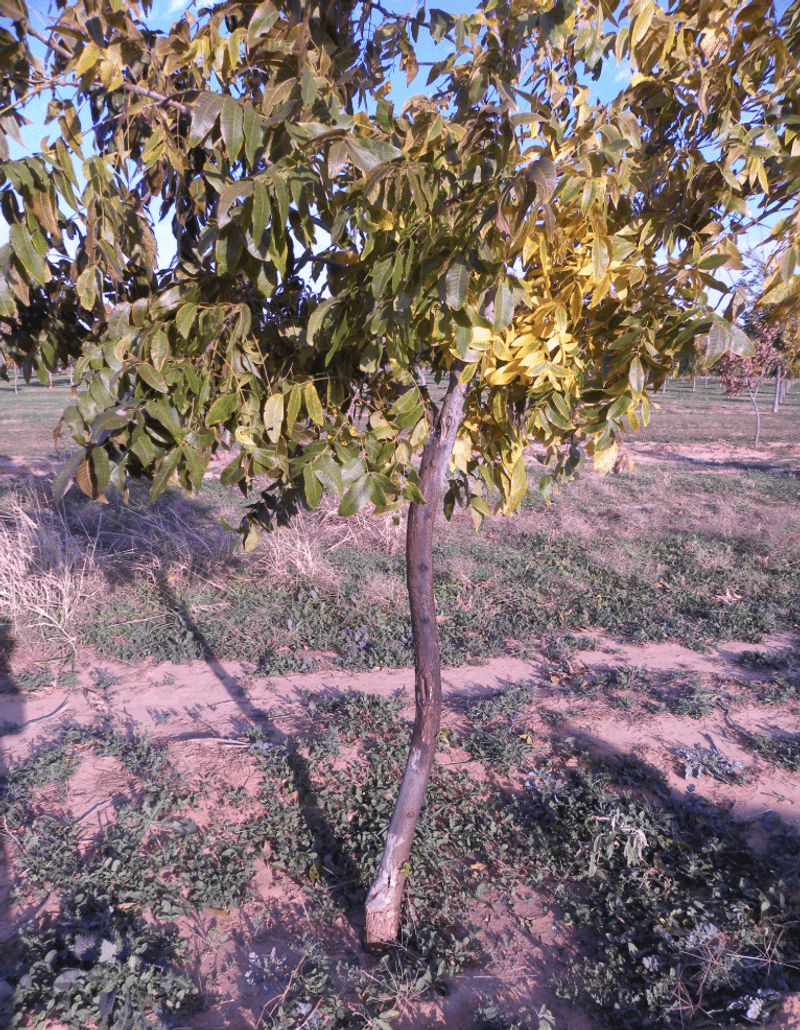
Watering a stressed tree sounds straightforward, but several situations make irrigation the wrong first move – or at least an incomplete one. Water-split is a good example.
In thin-shelled cultivars, a period of dry conditions followed by a sudden influx of moisture can create internal pressure that cracks the shell or shuck and aborts the nut. UGA’s guide to nutritional and environmental pecan disorders identifies water-split as a distinct problem tied to uneven moisture patterns rather than simple drought, which means the remedy is more nuanced than just adding water.
Insects can also produce drop that looks a great deal like stress-related abortion. Oklahoma State’s pecan weevil emergence alert notes that weevil activity can cause nuts to fall during the water stage with damage that is not always obvious at a glance.
Hickory shuckworm and pecan nut casebearer can also cause drop or affect kernel development, and their symptoms overlap with drought-related abortion. Irrigating more heavily will not address any of those problems and may not slow the drop at all.
Disease, poor pollination, drainage issues, and root decline are additional explanations that irrigation cannot fix. If your soil check reveals wet or waterlogged conditions and the tree is still dropping nuts, adding more water will reduce root-zone oxygen and worsen the situation.
Texas A&M AgriLife’s guide to managing pecan insect and mite pests recommends basing any treatment decision on an actual diagnosis rather than on symptoms alone.
Resist the urge to apply insecticide just because nuts are dropping. EPA guidance is clear that the product label governs legal and safe use, and preharvest intervals matter when a crop is close to maturity.
Fertilizer is similarly not an emergency fix. Dougherty County Extension’s mid-season fertilizer guidance notes that nutrient applications should be based on soil or leaf testing – not applied as a crisis response – and will not refill kernels that have already aborted.
When severe drop accompanies feeding signs, black stains, substantial leaf loss, or branch decline, contact your county Extension office for a diagnosis before treating anything.
Support the nuts that can still finish
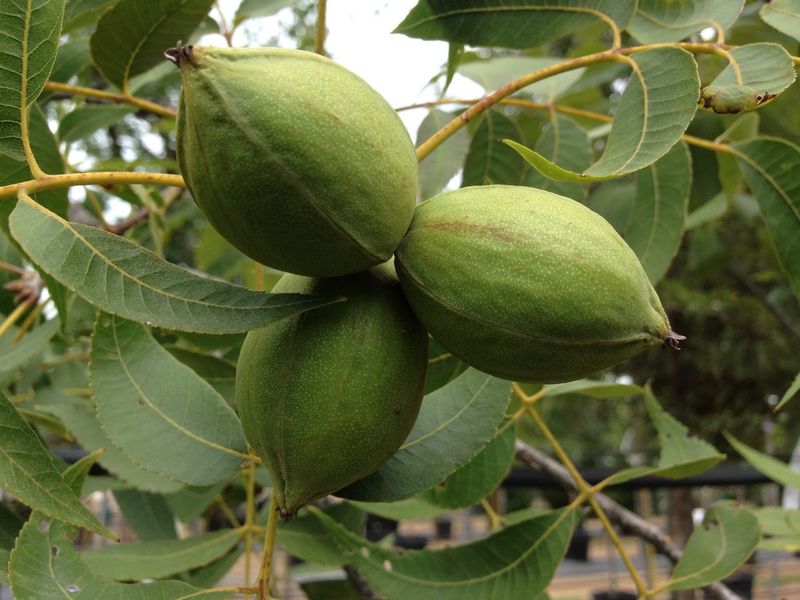
The most productive thing you can do right now follows a clear order. Start by inspecting the fallen nuts for punctures, staining, tunnels, or other signs that point beyond simple stress.
Then check the soil several inches below the surface near the dripline to determine whether the root zone is actually dry. If it is, apply a slow, deep soaking across as much of the root zone as practical, then maintain reasonably even moisture through the rest of the filling period without flooding or over-scheduling.
Texas A&M’s pecan problem evaluation guide and Oklahoma State’s home landscape fact sheet both recommend contacting your county Extension office when drop is severe or accompanied by insect signs, black stains, leaf loss, or branch decline. Those symptoms together suggest something beyond a dry-soil pattern, and a local specialist can help you identify it accurately.
Protect your foliage as long as possible. Leaves still working are still producing carbohydrates for the nuts on the tree now and the flowers that will set next year’s crop.
Texas A&M’s irrigation guidance reinforces that avoiding both extremes – severe dryness and waterlogged soil – is the most consistent way to support a tree through a difficult season. Steady moisture may help the nuts that are still developing reach a harvestable stage.
What it cannot do is bring back the ones the tree has already let go.