
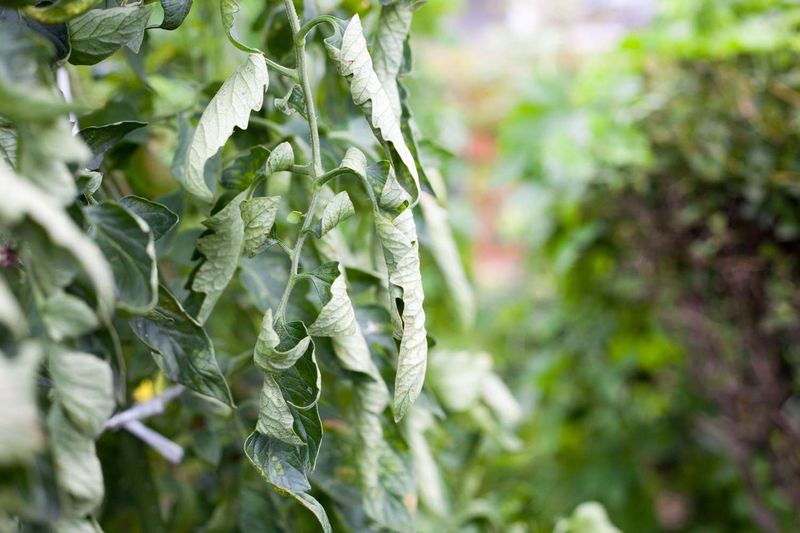
Late summer is rough on tomato plants in the South, and nothing worries a gardener faster than watching healthy-looking leaves suddenly curl up tight. Before you reach for a spray bottle or start pulling leaves off, take a breath, because the most common reason for this is far less alarming than it looks.
Understanding what your plant is actually telling you can save you from treatments that do more harm than good.
Green lower leaves favor physiological leaf roll
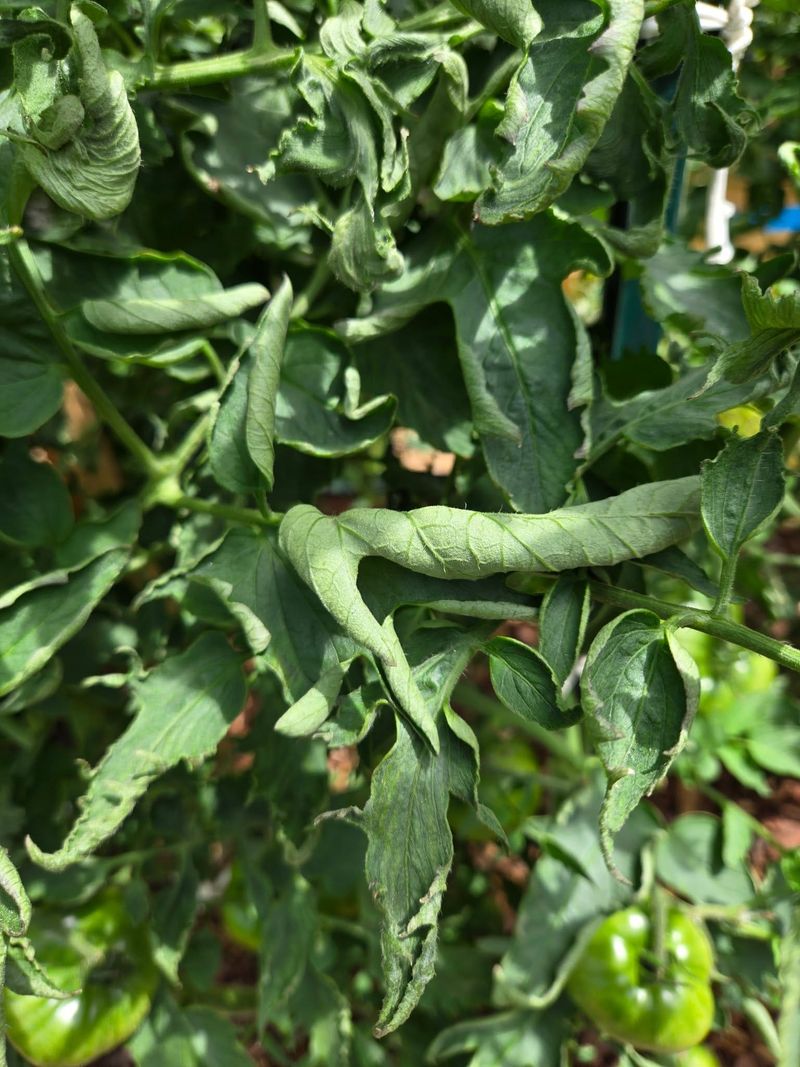
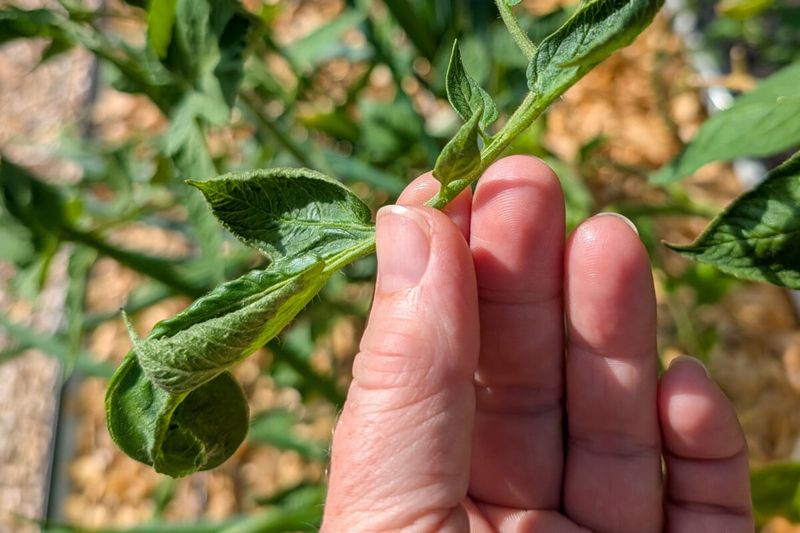
When older leaves near the bottom of a tomato plant start rolling upward and inward toward the midrib while staying a healthy green color, that specific pattern points toward physiological leaf roll. The affected foliage often feels thick, stiff, or leathery to the touch, yet the plant itself stands upright and the newer growth near the top looks relatively normal.
According to Clemson Extension’s tomato leaf rolling factsheet, this response is common, especially in warm weather, and it often has little or no effect on fruit quality or yield.
Recognizing this pattern matters because it narrows your diagnosis considerably. If the rolling starts on mature leaves, stays green and orderly, and does not spread into twisted or crumpled new growth, physiological leaf roll is the leading explanation rather than a disease or pest problem.
That said, this pattern is evidence that favors the diagnosis, not proof that nothing else is going on in the plant’s roots or surrounding soil.
True puckering, twisting, or deformation of new leaves is a different situation entirely and calls for a different investigation. The WSU Extension guide on physiological leaf roll makes clear that distorted new growth, yellowing, bronzing, stunting, or shortened internodes should not be lumped together with ordinary heat-related rolling.
Keeping those two categories separate is the first step toward figuring out what your plant actually needs.
Heat and uneven water uptake trigger the rolling response
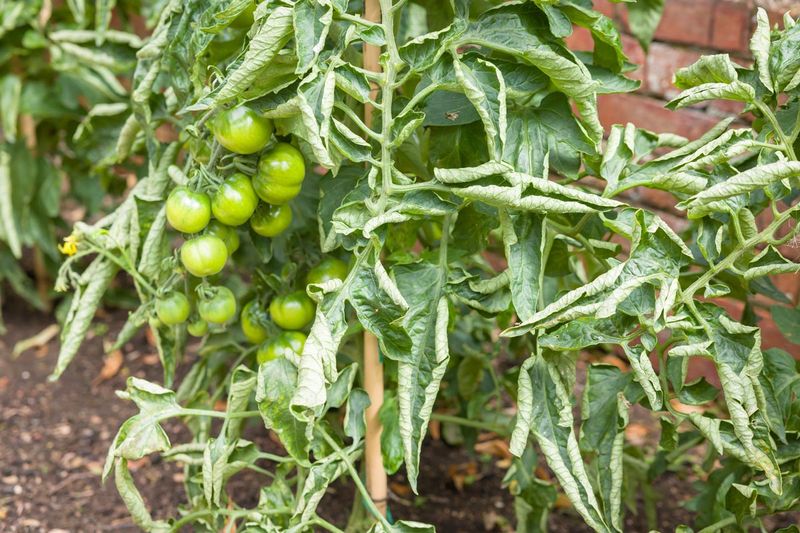
On a scorching August afternoon in Texas or Florida, a tomato plant can lose water through its leaves faster than its roots can pull moisture up from the soil. When that gap widens, the plant reduces the amount of leaf surface exposed to the air by rolling its leaflets inward.
Missouri IPM’s tomato leaf curl resource describes this rolling as a protective response to water stress rather than a disease symptom, which is why the leaves often stay green even as they curl tight.
Here is where many growers get tripped up: the problem is uneven water uptake, not necessarily dry soil. A plant growing in waterlogged or poorly aerated ground can show the same rolling because saturated roots cannot absorb oxygen and function properly.
Root disturbance from deep hoeing, transplant shock, or heavy pruning can also reduce the plant’s ability to move water upward, and WSU’s Hortsense factsheet lists excess nitrogen, heavy fruit load, and even cultivar genetics as additional factors tied to leaf rolling.
Certain indeterminate varieties are simply more prone to rolling than others, especially under late-summer pressure. University of Illinois Extension notes that the response can appear even on well-watered plants when temperatures climb high enough, which is why the fix is rarely as simple as adding more water.
Check moisture and drainage before watering again
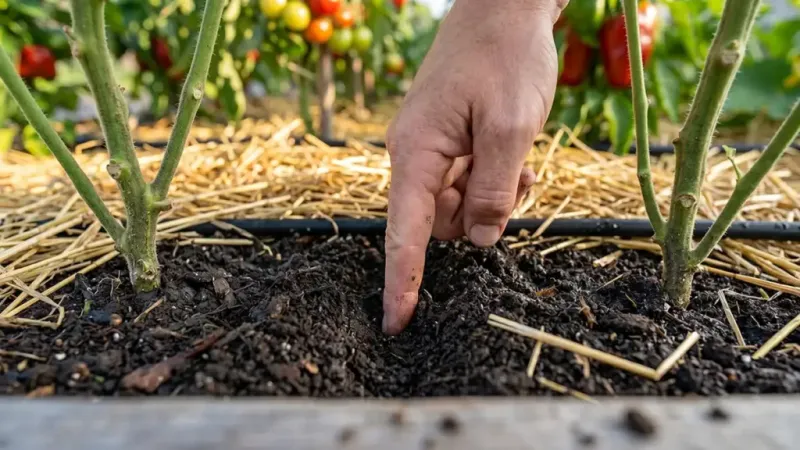
Curled leaves alone are not a reliable signal that your tomato needs more water. A better approach is to push a finger or a wooden dowel several inches below the soil surface and feel what is actually there.
Iowa State University Extension’s watering guide recommends checking soil moisture several inches down rather than judging by surface appearance or leaf symptoms alone, because the root zone can be quite wet while the top inch looks and feels dry.
If the soil at root depth feels genuinely dry and crumbly, slow and deep watering at the soil surface is the right response. University of Missouri Extension suggests that tomatoes generally need about 1 inch of water per week from rain and irrigation combined, but that figure shifts significantly based on soil type, container size, plant maturity, air temperature, and local conditions.
Sandy soils, raised beds, and containers dry out much faster than clay-based in-ground beds and often require more frequent attention.
If the soil feels soggy or waterlogged, adding more water will make things worse. Check whether the bed drains freely after rain, whether the container has adequate drainage holes, and whether compacted soil or a hardpan layer might be trapping moisture around the roots.
Compaction and poor drainage can injure roots just as effectively as drought, and ISU Extension’s tomato curling FAQ confirms that root problems from any source can trigger the same rolling response.
Use mulch and measured heat protection
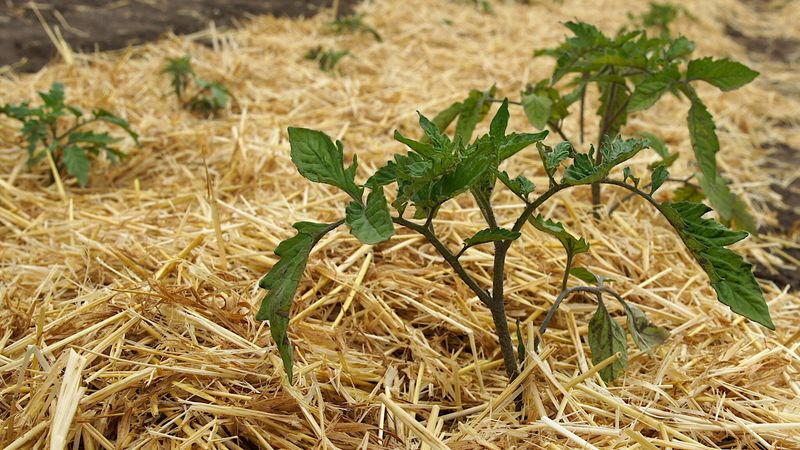
One of the most reliable ways to reduce heat-related stress on tomato roots is to keep soil temperature and moisture steadier throughout the day. A 2- to 3-inch layer of organic mulch, such as straw, shredded leaves, or wood chips, laid over the root zone can meaningfully slow evaporation and moderate soil temperature during afternoon heat spikes.
Iowa State University Extension’s tomato growing guide recommends mulching around plants while keeping the material a few inches away from the stem to avoid creating a moist environment that invites rot or disease at the crown.
Temporary shade can also reduce heat load on particularly brutal days. UC Master Gardeners of Contra Costa County discuss using breathable shade cloth to protect tomatoes when temperatures approach or exceed about 95 degrees Fahrenheit.
The key word is breathable: dense covers that trap heat or block too much light can create new problems, including reduced fruit production. Shade should be a targeted tool for extreme conditions, not a permanent fixture.
Avoid deep cultivation close to the root zone during hot spells, and resist the urge to do heavy pruning when plants are already stressed. University of Illinois Extension notes that removing healthy foliage exposes fruit and stems to more direct sun and heat, which can worsen the very stress you are trying to reduce.
Preserve useful leaves unless tissue is dead, diseased, or part of a confirmed management plan.
Skip automatic fertilizer and spray treatments
Reaching for fertilizer when tomato leaves curl is a common reaction, but it often backfires. Excess nitrogen encourages lush, water-hungry growth that can make leaf rolling worse, not better.
UF/IFAS guidance on tomato fertilization recommends feeding based on a soil test or product label rather than using nutrients as a symptom treatment, because adding calcium, phosphorus, Epsom salt, or nitrogen to a plant that does not need them can create salt buildup, nutrient imbalance, or other problems that complicate your diagnosis.
Healthy curled leaves do not need to be removed. Stripping them off exposes more of the plant to sun and heat and reduces the canopy that helps regulate temperature around developing fruit.
Clemson Extension advises against removing rolled leaves unless the tissue is dead, diseased, or severely damaged.
Pesticide and miticide sprays are equally inappropriate as automatic responses to unexplained curling. These products cannot cure physiological leaf roll, and they will not reverse an established virus.
WSU’s Hortsense resource specifically cautions against reflexive spraying. Targeted treatment with a labeled pesticide may be appropriate after a pest such as broad mites is positively identified, but UConn IPM’s broad mite resource notes that these pests require magnification or laboratory confirmation to identify reliably.
Oregon State Extension’s heat stress guide also warns that some sprays, including sulfur-based products, can injure tomato foliage when temperatures are high. Any pesticide use must follow the product label and local extension guidance.
Puckered or distorted new growth changes the diagnosis
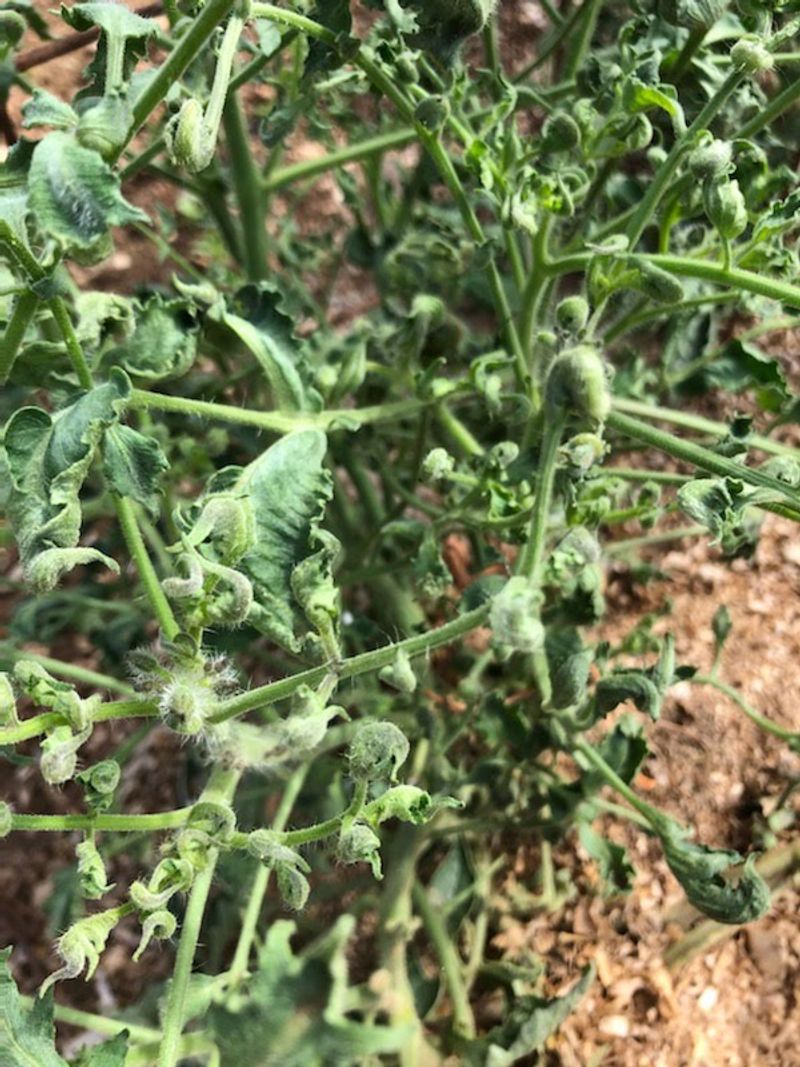
Orderly upward rolling on mature green leaves and genuine distortion of new growth are not the same problem. When the newest leaves at the top of the plant emerge twisted, crumpled, unusually small, cupped downward, or C-shaped, that pattern points toward something more serious than heat stress.
Texas A&M AgriLife Extension’s tomato leaf curl publication lists herbicide injury, viruses, broad mites, and aphids among the causes that can produce these more alarming symptoms, and it emphasizes that the pattern of affected tissue matters enormously for reaching the right diagnosis.
Herbicide drift or contaminated organic matter is one of the most common look-alikes for physiological leaf roll. Tomatoes are highly sensitive to 2,4-D, dicamba, and certain persistent pasture herbicides, and exposure can come from a neighbor’s yard application, wind-carried spray, or mulch made from grass clippings or hay that was treated with a persistent product.
University of Maryland Extension’s herbicide damage resource describes the resulting symptoms as downward cupping, twisted or fern-like new growth, and distorted stems, which look quite different from the upward rolling of physiological stress.
Yellowing leaf margins, stunting, shortened internodes, or small cupped leaves on new growth raise the possibility of tomato yellow leaf curl virus, especially in Florida. UF/IFAS guidance on tomato yellow leaf curl virus notes that this disease is spread by sweetpotato and silverleaf whiteflies and can cause severe yield loss with no curative treatment available.
UConn IPM adds that broad mites, which feed on young tissue and cause bronzing, russeting, and severe twisting, are too small to see without magnification and require laboratory help to confirm. South Dakota State University Extension reinforces that distorted new growth always warrants a closer look before drawing conclusions.
Heat may spare the leaves but reduce the harvest
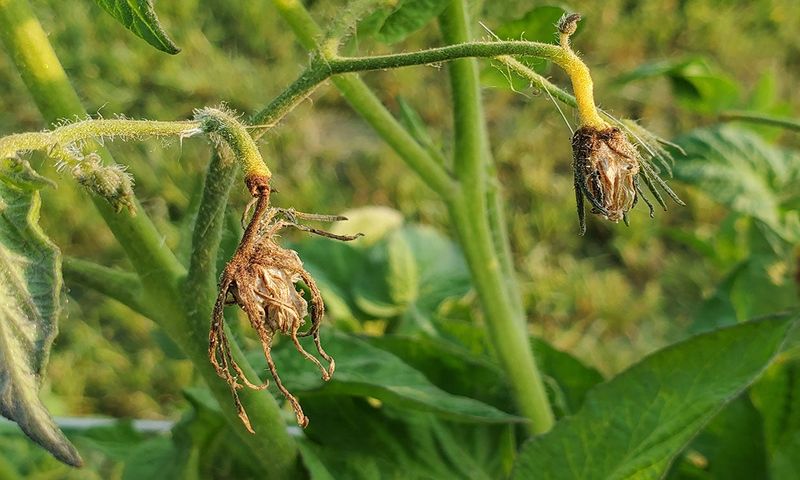
Even when physiological leaf roll turns out to be harmless, the heat that triggered it can still take a toll on your harvest in a completely separate way. High temperatures reduce the viability of tomato pollen and can prevent flowers from setting fruit, particularly when hot days are followed by hot nights.
UC ANR research on tomato heat tolerance documents how sustained high temperatures, especially warm nights, interfere with normal pollination and fruit development even on plants that look otherwise healthy.
For Florida growers, the concern extends beyond heat alone. UF/IFAS Florida gardening guidance notes that large-fruited tomato varieties may stop setting fruit when average nighttime temperatures stay very high through summer, while cherry and grape types generally tolerate Florida’s summer conditions better.
Florida gardeners should also watch actively for tomato yellow leaf curl virus, since UF/IFAS documentation on this virus confirms it is especially consequential in the state and spreads through whitefly populations that thrive in warm weather.
Texas growers face a different mix of pressures. Texas A&M’s tomato leaf curl publication identifies heat, low humidity, wind, blowing dust, herbicide injury, viruses, and broad mites as competing explanations when leaves curl or twist during summer.
Knowing your regional risk factors helps you decide quickly whether a symptom fits the ordinary stress pattern or needs a closer look from a local extension agent. The leaf curl itself may resolve as temperatures ease, but missed fruit set during a hot spell is a loss that cannot be recovered once the window closes.
Monitor the pattern and seek confirmation when needed
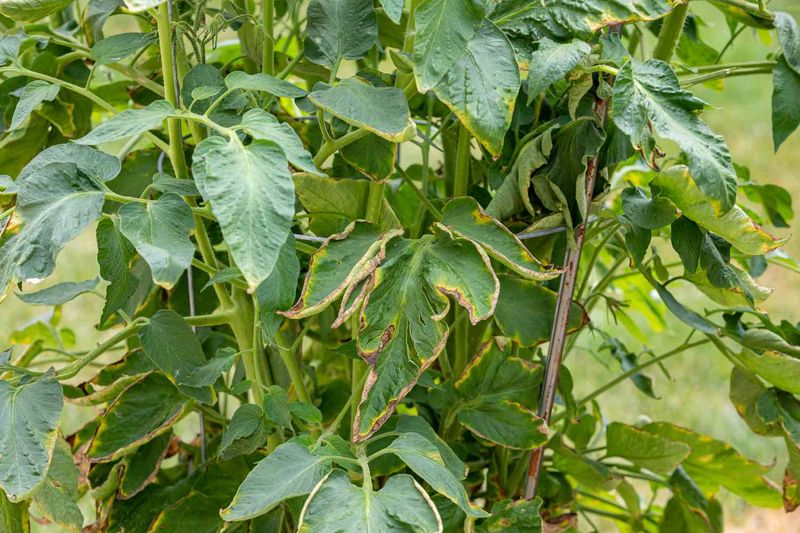
Green, upward-rolling leaves that begin on older growth during a heat wave most strongly support physiological leaf roll, so the first response should be a soil and root-zone check rather than automatic spraying or fertilizing. Clemson Extension and WSU Extension both confirm that steadier moisture management and reduced root disturbance are the appropriate responses when this pattern fits.
As temperatures drop and conditions stabilize, new growth may begin to look more normal on its own.
Persistent distortion, declining plant vigor, suspected herbicide exposure, symptoms that match virus descriptions, or possible broad mite activity should not be managed by guesswork. UF/IFAS guidance on tomato yellow leaf curl virus and Texas A&M’s diagnostic resources both recommend extension or laboratory confirmation for uncertain cases.
A correct diagnosis protects your current plants and every tomato you plan to grow next season.