
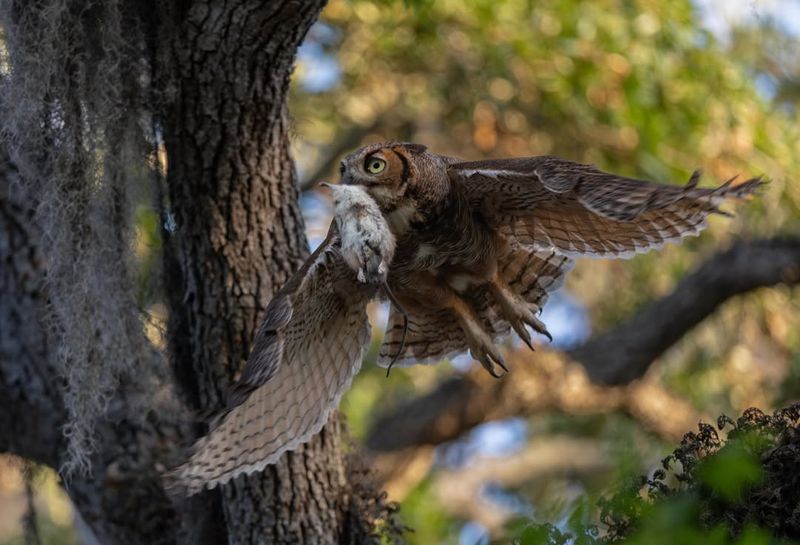
Great horned owls are some of Texas’s most powerful night hunters, and they happen to love snacking on rats. When you make your yard friendly to these big-eyed birds, you get a natural pest control team that works the night shift for free. Rats that once squeezed through your fence looking for food suddenly have to worry about silent wings dropping from above. This article breaks down eight simple ways owls help keep your yard rodent-free and how you can invite more of them to patrol your property.
1. One Owl Can Eat Thousands of Rats a Year

Picture a single bird quietly clearing out an entire rat family before you even finish dinner. A great horned owl eats roughly three or four rodents every single night, and when you add that up over a year, one owl can knock out well over a thousand rats and mice.
That number climbs even higher when the owl is feeding hungry chicks in the spring. Both parents hunt constantly, dragging back rats, mice, and other small critters to the nest. For a Texas homeowner, that means the pests hiding near your fence line become a nightly buffet.
Rats breed shockingly fast, with a single pair capable of producing dozens of babies in a season. Chemical traps and poisons only catch a handful at a time, but an owl keeps hunting every night without any effort from you.
The best part is that owls target the rodents where they travel, along fences, under sheds, and near woodpiles. These are the exact spots where rats slip in looking for shelter and scraps.
Fun fact: great horned owls have been recorded taking prey heavier than themselves, so a plump rat is an easy meal. Once a hunting pair claims your neighborhood as their territory, they return to the same feeding grounds again and again, giving your yard steady, round-the-clock protection you never have to plug in or refill.
2. Silent Wings Give Rats No Warning

Ever notice how you never hear an owl coming? That eerie silence is exactly why rats stand no chance in a yard patrolled by great horned owls. Special comb-like feathers on the edge of each wing break up the air, muffling the whoosh that other birds make when they flap.
Rats rely almost entirely on their ears to survive, since their eyesight is pretty weak. A rat can hear a hawk flapping or a cat’s paws crunching leaves, giving it time to bolt for cover. But an owl gliding overhead makes almost no sound at all.
By the time a rat senses trouble, the owl’s talons are already closing. This gives the owl a massive advantage during those dark hours when rats feel safest scurrying along your fence.
Nighttime is prime rat travel time, and it is also when owls do their best work. The two schedules overlap perfectly, which is bad news for the rodents and great news for you.
Their hearing is just as sharp as their stealth. Great horned owls can pinpoint the tiny rustle of a rat moving through grass in total darkness, then swoop down with pinpoint accuracy.
Because the attack comes without warning, rats never learn to expect danger from above. They keep using the same paths near your fence, walking right into the hunting zone of a bird they never hear until it is far too late.
3. Owls Patrol the Fence Line Where Rats Sneak In

Your fence is basically a rat highway. Rodents love running along the base of fences because the wood and posts give them cover while they search for gaps to squeeze through. Great horned owls seem to know this, and they love perching on fence posts to scan for movement below.
From a high perch, an owl gets a clear view of the whole yard edge. It sits patiently, head swiveling, waiting for the smallest twitch of a rat darting between shadows.
The moment a rodent breaks cover to cross an open patch, the owl drops. That is why the fence line, usually a weak spot in your defenses, becomes a danger zone once owls move in.
Rats trying to slip through holes in the boards suddenly have to gamble with their lives every trip. Many simply give up and look for an easier, owl-free yard somewhere else.
You can help this happen by leaving a tall dead tree or setting up a sturdy perch pole near your fence. Owls need a good lookout spot, and giving them one turns your fence into their favorite hunting stand.
Here is something neat: owls often reuse the same favorite perches night after night, almost like a security guard walking the same route. Over time, your fence line becomes their regular patrol beat, and the rats that once ruled that space quietly disappear.
4. Fewer Rats Means Less Disease Around Your Home

Rats do not just chew wires and steal pet food, they also carry germs that can make your family sick. Their droppings and urine spread bacteria across patios, garages, and sheds, and they can bring fleas and ticks along for the ride.
When great horned owls thin out the rat population, they cut down on all that mess too. Fewer rodents scurrying around means fewer dirty trails near your back door and less risk of contaminated food storage.
Diseases like hantavirus and salmonella are linked to rodent waste, so keeping numbers low actually protects the people you love. An owl doing its nightly rounds becomes a quiet health guard for your household.
Compare that to poison bait, which brings its own dangers. Pets and kids can accidentally reach it, and poisoned rats often crawl off to die in walls, creating a smell and a mess.
Owls skip all of those downsides. They remove the rat completely, leaving nothing rotting behind your drywall or under your porch.
There is a catch worth knowing, though. If you use rat poison in your yard, an owl that eats a poisoned rat can get sick and die. Choosing owls over chemicals protects the very birds keeping you safe.
By welcoming these hunters and skipping the poison, you build a cleaner, healthier yard where rats and their germs simply do not stick around for long.
5. Tall Trees and Perches Invite Owls to Stay

Owls will not hang around a yard that gives them nowhere to sit. These big birds need high, sturdy spots to rest, watch, and launch their attacks, so the more good perches you offer, the more likely owls are to claim your property.
Mature trees like live oaks, pecans, and tall pines are perfect natural lookouts, common across many Texas neighborhoods. If your yard already has one, you are halfway to hosting a hunter.
No big trees yet? You can install a tall perch pole, at least ten or twelve feet high, topped with a horizontal branch. Owls will often adopt these man-made perches surprisingly fast.
Position perches near open areas and along your fence, where rats travel most. The owl gets a front-row seat to the action, and you get better coverage of the spots rodents love.
Try to avoid trimming every branch off your trees for a super-clean look. Those messy limbs are exactly what an owl wants for cover during the day.
A helpful tip: keep bright yard lights off at night when possible. Owls hunt better in darkness, and glaring floodlights push both them and their prey to behave differently.
Once a great horned owl decides your trees make a comfy base, it tends to stay loyal to that territory for years. Give these birds a good place to sit, and they will happily handle your rat problem while enjoying the view.
6. Nesting Boxes Turn Your Yard Into Owl Territory

Want owls to move in for good? Give them a place to raise a family. Great horned owls do not build their own nests, they borrow old hawk or squirrel nests, and they will happily use a large open nesting platform you put up.
A wide, sturdy box or basket mounted high in a tree can convince a pair to settle down right on your property. Once they nest, they defend the surrounding territory fiercely, chasing off other predators and, of course, hunting rats to feed their young.
Spring is nesting season in Texas, with owls often laying eggs as early as January or February. That timing means hungry chicks arrive just as rat activity picks up with warmer weather.
Two parents feeding a nest full of owlets need a lot of food, and rats make up a big share of the menu. Your yard basically becomes their grocery store.
Mount the platform at least fifteen to twenty feet up, away from busy areas so the birds feel safe. Use rough wood so the owls and chicks can grip it easily.
Here is a fun detail: great horned owls are among the earliest nesters of any North American bird, sometimes sitting on eggs while snow still falls up north. In Texas, that early start gives you owl-powered rat control for most of the year, right when you need it most.
7. Owls Scare Rats Away Just by Being Nearby

Sometimes an owl does not even have to catch a rat to do its job. The mere presence of a predator changes how rodents behave, and that fear alone can shrink the number of rats hanging around your yard.
Rats are smart and cautious. When they sense an owl living nearby, through droppings, feathers, or the sound of hooting, they become jumpy and spend less time out in the open.
Scared rats move less, eat less, and even breed less. Scientists call this the “landscape of fear,” and it means one owl scares far more rats than it ever actually eats.
Those nervous rodents often decide your yard is too risky and relocate to safer ground. That is a win for you without a single trap being set.
The steady sound of a great horned owl calling at night, that deep hoo-hoo-hoo, sends a clear message across the neighborhood: a hunter is on patrol here.
You can boost this effect by keeping your yard tidy so rats have fewer hiding spots to feel brave in. Combine hunger, exposure, and constant owl pressure, and the rodents crack quickly.
Think of it like having a guard dog that never sleeps and never needs feeding. Even on nights the owl catches nothing, its shadow overhead keeps the rat population anxious, thin, and always looking for an exit far from your fence.
8. Protecting Owls Keeps Your Free Pest Control Working

An owl that keeps your yard rat-free deserves a little protection in return. These birds face real dangers, and losing them means the rats come roaring right back within a season or two.
The biggest threat is rat poison. When an owl eats a rodent that swallowed bait, the poison builds up in its body and can kill it slowly. Skipping poisons entirely is the single best way to keep your owls alive.
Fast-moving cars are another hazard, since owls hunt low along roadsides. There is not much you can do about traffic, but you can avoid tossing food scraps near the road that lure prey there.
Keep your outdoor cats inside at night too. Cats and owls compete for the same rodents, and a bold owl might even tangle with a small pet.
Leave dead trees standing when they are safe, since these snags make ideal perches and roosts. A little wildness in your yard goes a long way for owl comfort.
Provide a shallow water source if you can, especially during hot Texas summers when owls need to drink and cool off.
Remember that great horned owls are protected by law, so it is illegal to harm them or disturb their nests. Treat these birds as valued neighbors, and they will reward you with years of quiet, tireless rat control that no store-bought gadget can ever match.